Human-First Processes: Technology Should Work for You
Every organisation understands how important digital transformation is in the face of rapidly evolving competition, but many are put off by the thought of dealing with replacing legacy systems or facing up to technical debt.
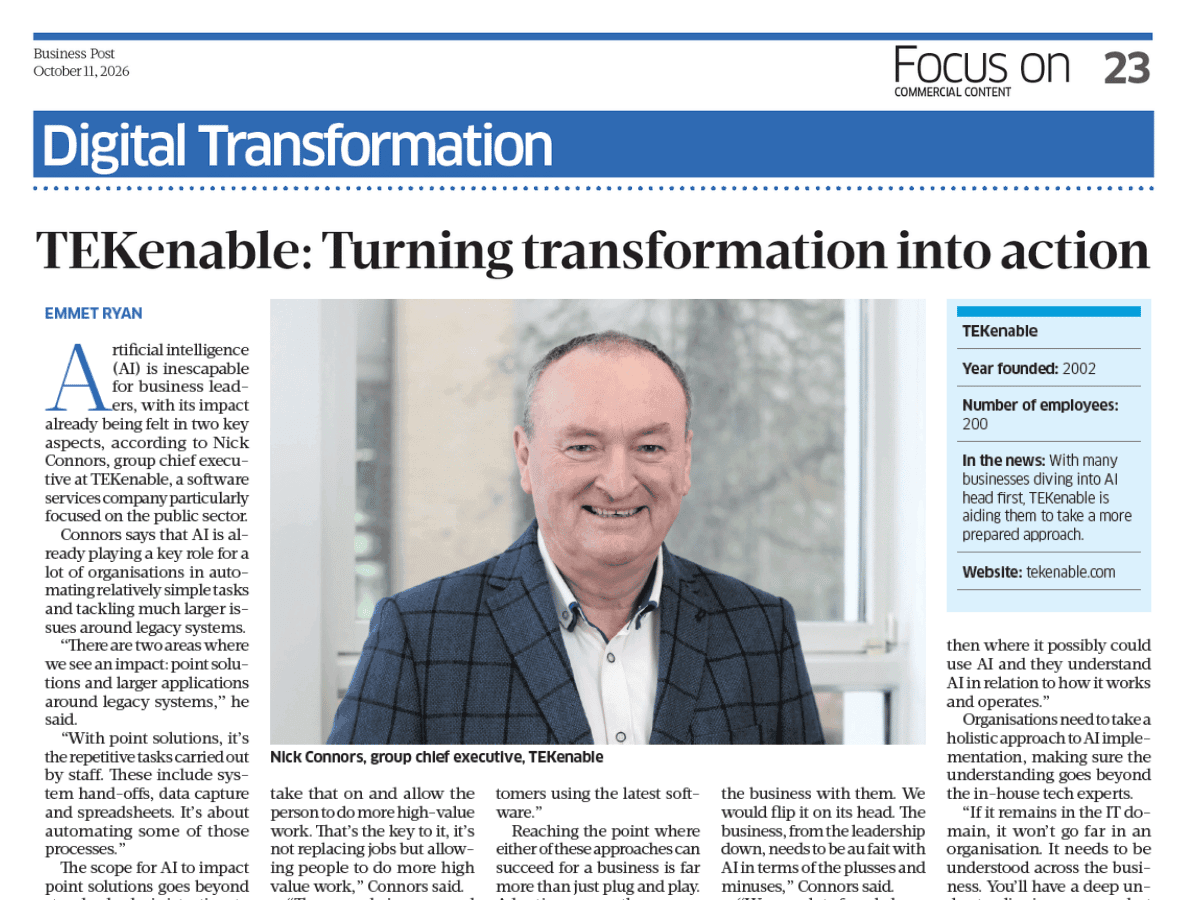
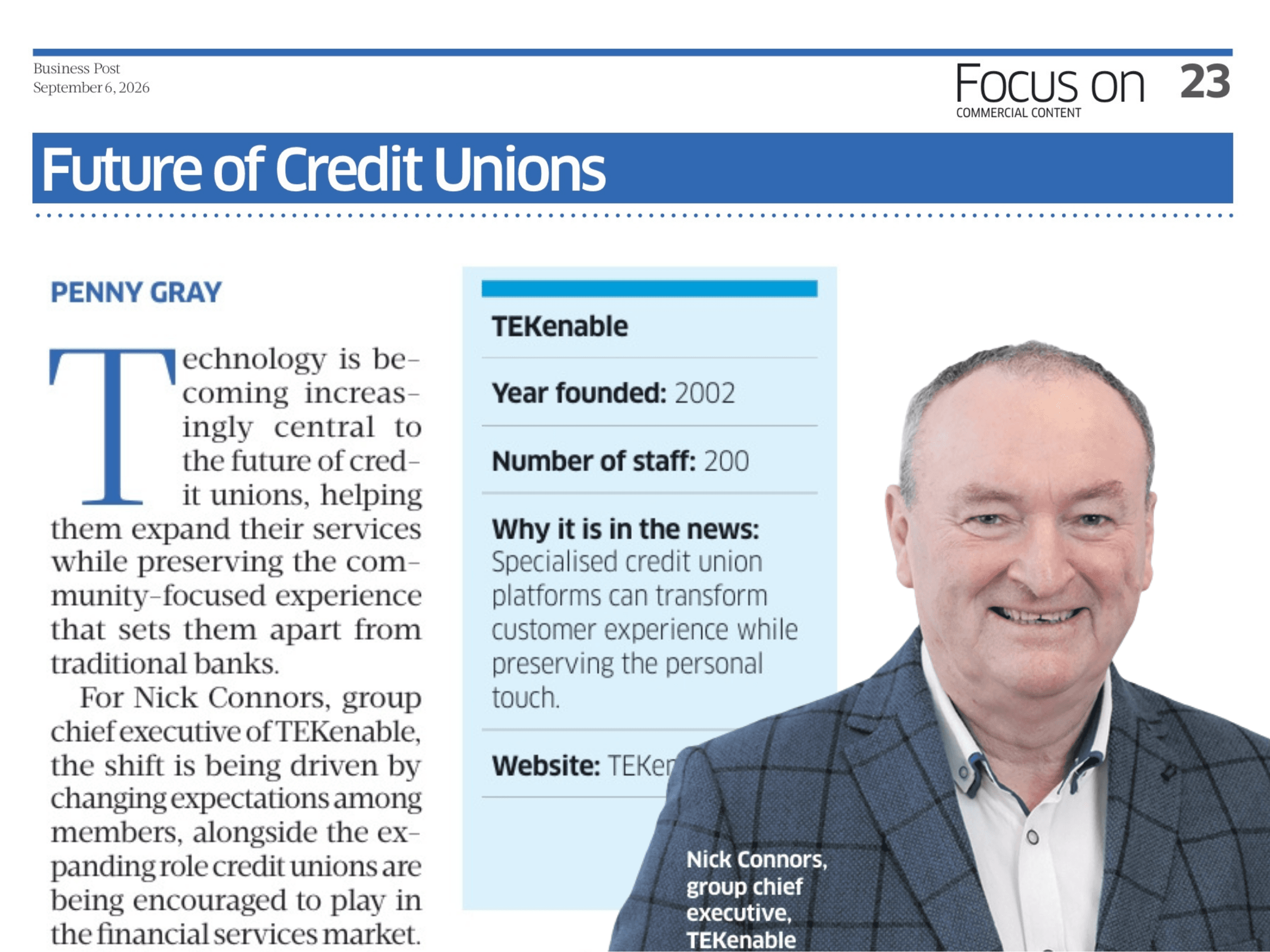
This need not be the case, said Nick Connors, group chief executive of transformation specialists TEKenable.
“To be quite honest, we do it so often that the integration is typically very straightforward,” he said.
“As a result, we look more at the needs of the business than the technology: we find out what they are doing today and what they want to do tomorrow. We configure the platform and integrate the data into it to bring it to life. Once you have the right partner, they’ll do it for you, because that’s their business,” he said.
Human-First Processes: Redesigning Inefficient Legacy Workflows
This is not to say that old technology is never an issue, but even when systems are indispensable – say, batch processing, for instance – there are means to integrate them with the all-singing, all-dancing, all-live-reporting systems that users today have a right to expect.
“You do come across obscure legacy systems, so you can write an API [application programming interface] to push and pull the data securely to and from it,” Connors said.
So, if technology is not the barrier to business transformation, then, what is?
The key, Connors said, is to focus on process and people, not technology – and for this reason TEKenable prefers the term ‘business transformation’ to ‘digital transformation’.
The whole point, Connors said, is that while people and organisations need technology, they should not be working for it. Instead, the technology should work for you.
“Most organisations do have a significant technology footprint and have made significant investments, so it’s in their interest to know how to use it to best support their business. In bygone days, technology used to just be a small part of the business, but today you can’t really work without it.
“However, the key is to understand that the people, processes and data come first,” he said.
Many of TEKenable’s artificial intelligence (AI) projects are currently in regulated sectors that have significant data pools, or use paper and manual processes, Connors said.
Human-First Processes: Overcoming Fear and Enabling Change
“There’s inertia, fear. Decision-making stops because of fear of the unknown”
In many cases, work processes in use today were built around manual work practices or legacy systems, and these are mainly very inefficient, which is why it is important to design new processes on the new platform to create efficiency, Connors said.
“We delivered AI into a state agency [that] has to redact hundreds and thousands of documents across multiple case files, and if even one word is not redacted properly it could cause significant exposure for the persons in the file from a medical, legal or financial perspective,” he said.
For this, he said, the business case is very clear: AI is more accurate than a human checking documentation.
“We ran the software over historical cases and found errors. Secondly, the large teams of people employed to do that work can address more complex cases where you need human intervention and so the overall agency is far more efficient.”
Connors further argues that moving away from old technology is not just about efficiency, but managing risk.
Remaining on legacy systems is a much greater risk than moving to a new cloud-based platform, Connors said, as new platforms are far better equipped to provide the necessary data governance, security, and risk mitigation.
“Companies like Microsoft have invested millions on the best of breed in data governance [and] security,” he said, noting that while cyber attacks on companies are common, they often go under the radar due to the significant reputational damage they cause.
In the end, the result of serious transformation will prove positive, he said.
“Today, most of the cloud platforms now have AI built in as part of the functionality. As an example, Microsoft’s finance system, Business Central, has AI fully integrated into the platform so that non-accountants can query the system in plain English and ask for reports, figures et cetera. This is very beneficial for not only the finance team but also for business owners, operations, etc who may need financial information [which] in the past was never accessible.”
Technology is available and the benefits are clear, then, but Connors suggests that just as the real goal is human rather than technical, so too the real barrier is also not technical, but human.
“It’s a little bit of everything: inertia, fear. Decision-making stops because of fear of the unknown. Lack of knowledge is an issue. If they understood it better, they would make the decision.
“What we do with our existing customers is run half-day workshops to help give them some understanding of how the new technologies relate to their business, and how it is creating change. You have to know about it and understand it before you can implement it,” he said.
The above text was reproduced from the interview published in Business Post on October 13th, 2025.
FAQ: Human-First Processes in Business Transformation
What does “human-first processes” mean in digital transformation?
It refers to designing transformation strategies that prioritise people and workflows over technology. Rather than forcing teams to adapt to new tools, the tools are configured to support how people work best.
Is legacy technology a barrier to transformation?
Not necessarily. TEKenable often integrates legacy systems using APIs to securely push and pull data. The real challenge is overcoming fear and inertia in decision-making.
How do human-first processes improve efficiency?
By redesigning outdated, manual workflows on modern platforms, organisations can automate repetitive tasks and free up staff to focus on higher-value work. For example, AI can handle document redaction more accurately than humans, allowing teams to focus on complex cases.
What role does AI play in human-first transformation?
AI enhances human capabilities by automating tasks that are error-prone or time-consuming. In regulated sectors, it improves accuracy and reduces risk—while enabling staff to focus on strategic or sensitive work.
What are the risks of staying on legacy systems?
Legacy systems often lack modern data governance, security, and scalability. Connors argues that remaining on outdated platforms poses greater risks than migrating to cloud-based solutions.
Why does TEKenable prefer the term “business transformation” over “digital transformation”?
Because the focus is on improving business outcomes through better processes and empowered people—not just implementing new technology. As Nick Connors puts it, “technology should work for you, not the other way around.”