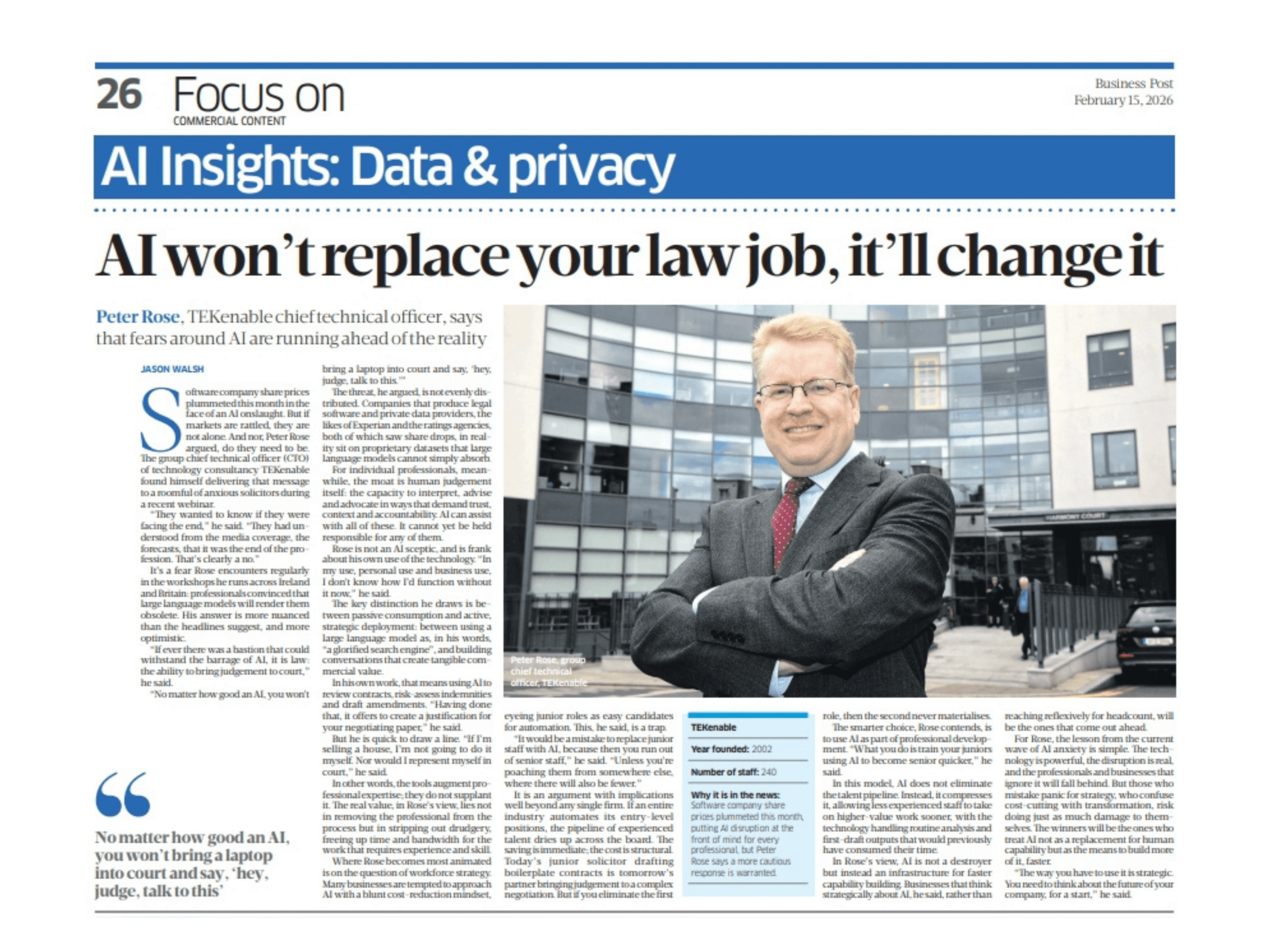
Peter Rose, Group Chief Information Officer, TEKenable: ‘Software company share prices plummeted this month in the face of an AI onslaught. But if markets are rattled, they are not alone. And nor, do they need to be. ‘
“They wanted to know if they were facing the end,” he said. “They had understood from the media coverage, the forecasts, that it was the end of the profession. That’s clearly a no.”
It’s a fear Rose encounters regularly in the workshops he runs across Ireland and Britain: professionals convinced that large language models will render them obsolete. His answer is more nuanced than the headlines suggest, and more optimistic.
“If ever there was a bastion that could withstand the barrage of AI, it is law: the ability to bring judgement to court,” he said.
“No matter how good an AI, you won’t bring a laptop into court and say, ‘hey, judge, talk to this.’”
The threat, he argued, is not evenly distributed. Companies that produce legal software and private data providers, the likes of Experian and the ratings agencies, both of which saw share drops, in reality sit on proprietary datasets that large language models cannot simply absorb.
For individual professionals, meanwhile, the moat is human judgement itself: the capacity to interpret, advise and advocate in ways that demand trust, context and accountability. AI can assist with all of these. It cannot yet be held responsible for any of them.
Rose is not an AI sceptic, and is frank about his own use of the technology. “In my use, personal use and business use, I don’t know how I’d function without it now,” he said.
The key distinction he draws is between passive consumption and active, strategic deployment: between using a large language model as, in his words, “a glorified search engine”, and building conversations that create tangible commercial value.
“No matter how good an AI, you won’t bring a laptop into court and say, ‘hey, judge, talk to this’”.
In his own work, that means using AI to review contracts, risk-assess indemnities and draft amendments. “Having done that, it offers to create a justification for your negotiating paper,” he said.
But he is quick to draw a line. “If I’m selling a house, I’m not going to do it myself. Nor would I represent myself in court,” he said.
In other words, the tools augment professional expertise; they do not supplant it. The real value, in Rose’s view, lies not in removing the professional from the process but in stripping out drudgery, freeing up time and bandwidth for the work that requires experience and skill.
Where Rose becomes most animated is on the question of workforce strategy. Many businesses are tempted to approach AI with a blunt cost-reduction mindset, eyeing junior roles as easy candidates for automation. This, he said, is a trap.
“It would be a mistake to replace junior staff with AI, because then you run out of senior staff,” he said. “Unless you’re poaching them from somewhere else, where there will also be fewer.”
It is an argument with implications well beyond any single firm. If an entire industry automates its entry-level positions, the pipeline of experienced talent dries up across the board. The saving is immediate; the cost is structural. Today’s junior solicitor drafting boilerplate contracts is tomorrow’s partner bringing judgement to a complex negotiation. But if you eliminate the first role, then the second never materialises.
The smarter choice, Rose contends, is to use AI as part of professional development. “What you do is train your juniors using AI to become senior quicker,” he said.
In this model, AI does not eliminate the talent pipeline. Instead, it compresses it, allowing less experienced staff to take on higher-value work sooner, with the technology handling routine analysis and first-draft outputs that would previously have consumed their time.
In Rose’s view, AI is not a destroyer but instead an infrastructure for faster capability building. Businesses that think strategically about AI, he said, rather than reaching reflexively for headcount, will be the ones that come out ahead.
For Rose, the lesson from the current wave of AI anxiety is simple. The technology is powerful, the disruption is real, and the professionals and businesses that ignore it will fall behind. But those who mistake panic for strategy, who confuse cost-cutting with transformation, risk doing just as much damage to themselves. The winners will be the ones who treat AI not as a replacement for human capability but as the means to build more of it, faster.
“The way you have to use it is strategic. You need to think about the future of your company, for a start,” he said.