The AI paradox: startups and giants face-off in the tech fight
– Peter Rose, Group Chief Technical Director, TEKenable
According to the received wisdom, the big boys will beat the upstarts, at least as far as artificial intelligence (AI) goes. After all, not only is AI expensive to implement but it demands specialist skills, and it’s the large enterprises that have their war chests at the ready. Not so fast, though. According to Amazon, a ‘two-tier’ AI economy is emerging, with startups rapidly adopting AI technologies, while larger corporations are left to fiddle at the edges.
According to Tanuja Randery, Amazon Web Services’ (AWS) managing director for Europe, the Middle East, and Africa (EMEA), the agility of startups allows them to integrate AI into their core business models, while large enterprises are primarily using AI for simple productivity improvements.
Speaking to US business magazine Fortune, Randery claimed smaller businesses were now demonstrating a fundamentally different, and superior, approach to AI adoption compared to established enterprises.
“Startups are really leveraging AI to build entirely new products and business models. So it’s not just experimentation – it’s really embedding it in the core of everything that they’re doing [while] enterprises are largely still experimenting around productivity,” she said.
We should take this vision of speedy startups and lumpen incumbents with a salt mine’s worth of seasoning, of course. Amazon is no startup and its fortune is built on delivering a technology platform – including, yes, AI – to over a million AWS customers.
Still, Amazon claimed, in a report published in February, that 68 per cent of startups had integrated AI into their operations, compared to 53 per cent of large enterprises. Furthermore, 37 per cent of start-ups are developing new AI-driven products, whereas only 13 per cent of larger companies are doing the same, it said, a disparity that suggests that start-ups are innovating with AI more effectively than their larger counterparts.
THE AI ADVANTAGE
One fair point is that, in spite of lacking the wheelbarrows full of cash enjoyed by enterprises, smaller businesses have an inherent advantage in AI adoption due to their agility and lack of dependence on legacy systems.
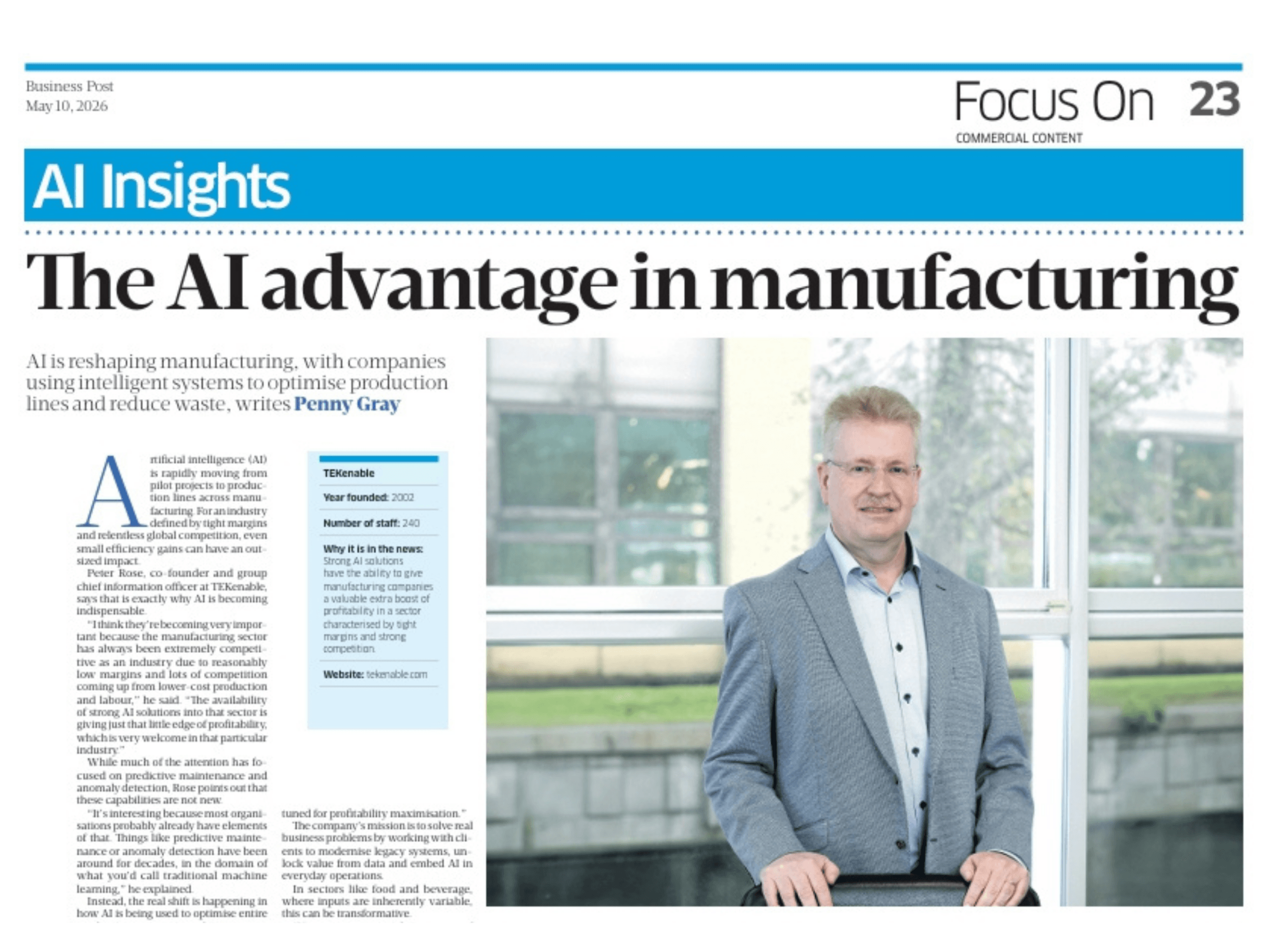
Peter Rose, group chief technical officer at developer TEKenable, which is deploying AI-based tools for clients, says startups are in a prime position as they are unburdened by technical debt and bureaucratic processes, allowing them to rapidly integrate and deploy AI.
“The thing about AI is that it is running on platforms like [Microsoft] Azure, so it doesn’t require capital investment in infrastructure. When you combine this with the fact that smaller companies can deploy, test and iterate quickly – essentially bringing innovative products to market faster – you can see their advantage over larger competitors.”
Will this change the roster of tomorrow’s household names? It might, according to Rose. “In a sense, this is a natural development, and really nothing new.”
Of course, this rather implies a certain level of Joseph Schumpeter’s ‘creative destruction’ that will see the startups of today become the behemoths of tomorrow. This is indeed a story as old as the hills, with new businesses rising up and displacing incumbents only to later themselves be displaced by new, leaner and hungrier competitors.
Also as old as the hills is Kongo Gumi Co, Ltd, a Japanese construction firm purportedly founded in 578 CE and still in business today. Most businesses are rather less longlived: by 2020, the average lifespan of companies had further declined, with the average tenure of firms on the S&P 500 dropping to just 21 years, according to a report by consultants Innosight. In 1958 that figure was 61 years.
The business landscape, and indeed the business shelves of airport bookshops, are littered with the stories of dead corporations, not to mention those that are now a shadow of their former selves. Think Kodak, Polaroid, Blockbuster and Tandy Radio Shack, former giants, one and all.
And yet, today’s band of 800-pound gorillas is proving remarkably resilient.
At the time of writing, the major US stock market index, the S&P 500, has been slipping due to wariness about Donald Trump’s plans to impose trade tariffs. However, at over 5,700 it is still hovering near all-time highs – a far cry from the dog days of 2022 when it dropped, top to bottom, some 22 percent. It has all been green since then, rising 60 percent from the doldrums of October 2022. But, look a little closer and a slightly different picture starts to emerge: in January, financial services firm Morningstar (best not confused with communist newspaper The Morning Star) noted that “of the 24.09 percentage points gained by the US Market Index in 2024, 13.2 came from just eight stocks”. Which eight? Nvidia, Apple, Amazon, Meta Platforms, Tesla, Broadcom, Microsoft and Alphabet.
In other words, the tech giants which, with the exception of valuation wildcard Tesla, also happen to be the largest companies in the world. So, even if big companies have historically become slow and bureaucratic it is clear enough that today’s tech giants intend to stay on top, notably by using their platform status to exert power over not just customers but also potential competitors.
FOR SALE
Some business sectors are already so thoroughly dominated by just a few incumbents that small players struggle to break through. Take e-commerce, for example.
Ronan O’Brien, managing director of Irish e-commerce outfit Zatori Results, says that online retail is a tough business, and one that requires a relentless focus on customer service to succeed.
“My standpoint is: we’re going to be better, we’re going to have products in stock and we’ll get them delivered on time,” he says.
Even then, the challenges are enormous – and not always obvious. For example, so-called ‘blitzscalers’ attempt to flood the market to grab customers at any cost.
“There are a lot of people trying to compete with people who are going bust,” he adds.
Even without facing competition uninterested in actually making any money, the challenges are great. One of the greatest is simply the sheer scale of algorithmic champion Amazon, which is now at the point where it sells at least some version of almost everything and has scads of data about consumer behaviour. No doubt, this can be tough to fight, especially as Amazon has given no quarter not only to competitors but even to sellers paying to use its platform as their shop window.
Zatori Results targets specific market niches through its brands TheMobilityShop.ie, TheCostumeShop.ie and BuyTrophies.ie.
In addition to finding the right niche, marketing is crucial, O’Brien says, and that means spending on advertising and customer acquisition – including spending that has to be directed to one of the other tech giants.
“You have to pay to play; you have to pay Google. There is no way around that. You also need to deliver an exceptional product. Our customers come back to us every year, and we built up an e-mail list,” he says.
This means facing the reality that small players need to invest in order to compete with larger incumbents.
“People [returning customers] type our name into Google, so we pay for ads based on our name [in order to] to stop someone else using it as a keyword,” he says. Caroline Dunlea of Digital Business Ireland, a representative body established in 2019 to serve as the voice of Ireland’s digital commerce sector, agrees, saying that competing means taking marketing seriously.
“Businesses need to build their brands and use them to really deliver for customers in order to build brand loyalty,” she says. “In today’s market, a strong online presence is an essential part of building that brand loyalty, especially when competing with established giants.”
This strategy of targeted marketing and exceptional service creates a viable path for smaller e-commerce businesses despite the dominance of the giants. The question remains, however, whether similar approaches can work in other retail sectors, particularly those with different purchasing patterns and consumer expectations.
Indeed, retail is not really a single sector. Buying a car is very different from buying a book, though buying a house is arguably a bit like buying a joke book. Some areas of retail are relatively resistant to distant challengers. Take food, for example: whatever Amazon is doing in grocery sales, it seems unlikely to try competing with chippers. However, there is a surprising amount of technology being deployed, including algorithmic intelligence, in food ordering and delivery.
Ed Carty, chief executive of Captiva POS, an Irish firm that offers an integrated suite of cloud-based tools for restaurants and takeaways, says combining technology that helps understand customers with a sense of being a truly local service is a winning combination.
“The local issue is a huge difference. Local means community, and that’s becoming stronger and stronger. That local coffee shop, local café, local restaurant; people get to know the owners and the staff,” he says.
“They can meet individuals’ needs [and] with collection there is still that human touch, too.”
However, the technology is increasingly sophisticated. Captiva, which provides ordering, payments, back-office and marketing software, also integrates with outside delivery platforms that allow small players to expand their reach and streamline their operations.
“The platforms are an advantage; they provide a pretty good service for a small return. It means they [the restaurants] don’t need to have their own delivery drivers,” he says.
SHINING INTELLIGENCE
If SMEs are in pole position then that is good news for little Ireland. According to Central Statistics Office (CSO) figures, SMEs, which it defines as employing 250 or fewer staff, account for a jaw-dropping 99.8 per cent of all enterprises, and 69.2 per cent of jobs. If you think 250 sounds hefty enough, consider this: the CSO also found that so-called ‘micro enterprises’, which employ fewer than ten people account for 92.6 per cent of all active businesses, and 27.6 per cent of employed persons.
Given this, a win for SMEs could be seen as a win for a country that is short on large enterprise. Nevertheless, on the question of whether large or small companies will win the AI arm wrestle, both can get a metaphoric grip on the table by taking a strategic approach to AI implementation.
This should start with focused ‘lighthouse projects’ to demonstrate value and build internal expertise, said Brian Herron, director at user-experience design house Each&Other.
“There’s a difference between setting up proof of concepts – which can take days – and getting something release-ready, which can take months. Smaller, less complex organisations often means that the capability to release is lower,” he says.
Herron is not saying that means we should forget about AI. “We’re strong advocates, with our AI partners Phased AI, of running lighthouse projects. These are targeted, high-impact, modest investment projects that allow large organisations to start to gain benefits or AI technologies within a structured programme, learn as a team and adopt best practice as you deliver results.”
This balanced approach – starting small but thinking strategically – is intended to allow both established corporations and agile startups to use AI effectively but differently. While startups and SMEs may naturally integrate AI into their DNA, large organisations can systematically transform their operations through carefully planned projects.
Paul Sweeney, chief strategy officer of Limerick-based conversational AI agent developer Webio, says predictions on who is going to succeed and who may fail will be on stronger ground if based on an understanding of what is going on inside the business.
“My advice is, follow the data strategy: which ones have an actual data strategy and which ones do not. For instance, it has emerged that Klarna, and their much-vaunted ditching of SaaS such as Salesforce.com for LLM-driven AI, was actually built on a really solid data transformation programme and not ‘magic’ after all! To me, that’s a real clue as to who will gain advantage here,” he says.
The AI paradox, then, isn’t about which type of company will ultimately win, but rather how different types of organisations can harness the same technology through distinct implementation strategies.
If AI is really going to change things as much as we are told (and, despite the hype, the jury is still out on that one), then the most successful companies, regardless of size, will likely be those that understand their own inherent advantages and limitations – and build their AI strategy accordingly.
“We’re seeing this approach is particularly successful with large financial institutions where enormous efficiencies are very possible – especially in internal processes – but where adoption must be approached thoughtfully and risk managed,” Herron says.