Artificial intelligence and machine learning promise to transform businesses, but it does not mean processes have to be disrupted
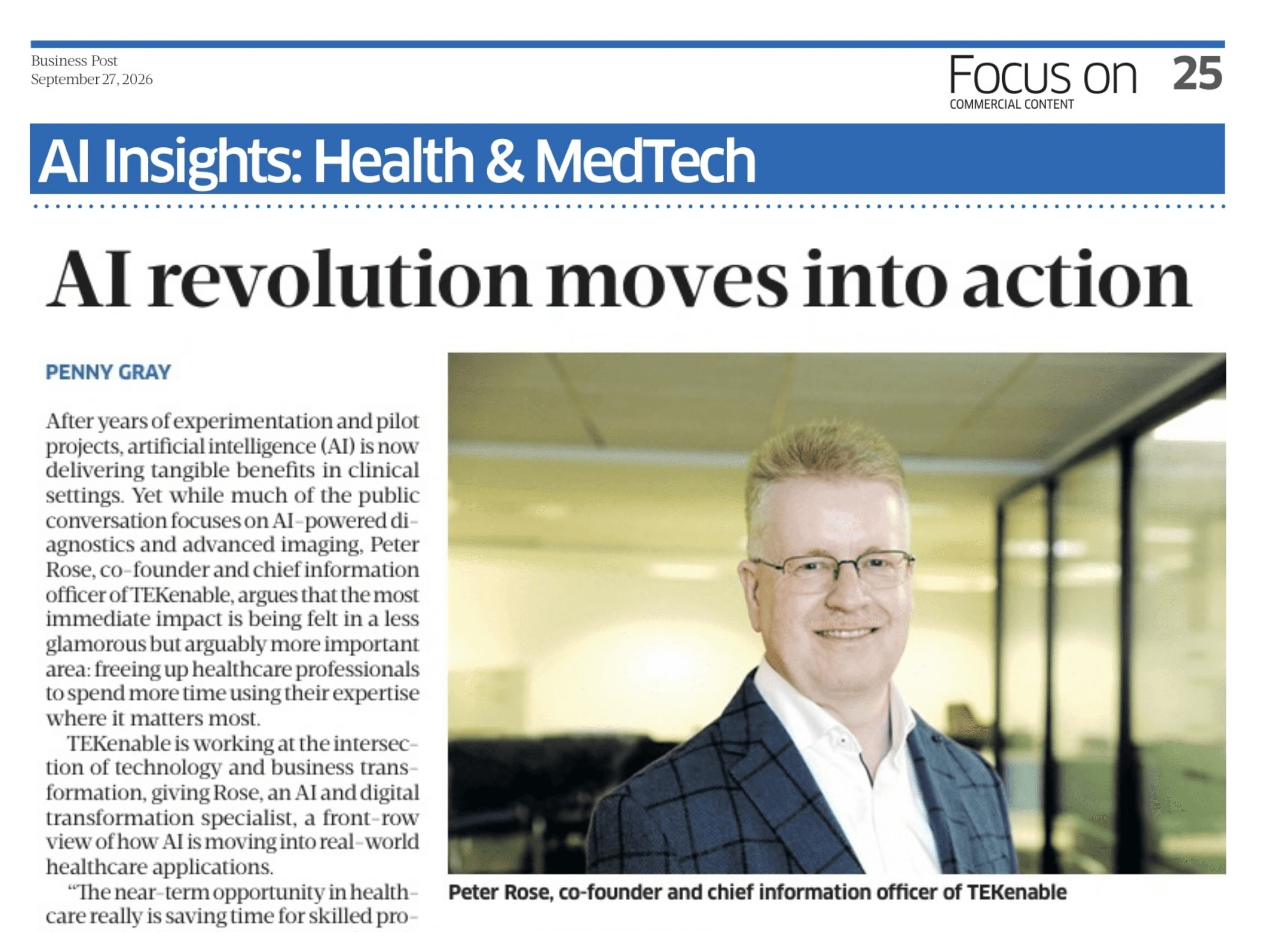
Peter Rose, Group Chief Technical Director, TEKenable
From “data is the new oil” to the generative artificial intelligence (AI) revolution, many of us are now familiar with the refrain that the analysis of data points is key for the future of business.
And despite a surplus breathless commentary, the importance and utility of data is hard to deny. In recent years, sectors such as insurance, healthcare delivery, medical research, and of course advertising have been, if not quite stood on their heads, certainly changed radically by our growing ability to both drill deeper and to cast the net wider.
However, as with any significant shift in technology or operations, it can be daunting. From the boardroom to the lunchroom, questions abound about: what can we do and, most pressing of all, what are our competitors doing?
Peter Rose, group chief technical director at developer TEKenable, said that while it was increasingly clear that AI and data represent a potential sea change for many businesses, it was not necessary to rip everything up and start again.
Instead, organisations that have dabbled with AI can continue to experiment and add functionality and AI workflows, thus building up expertise. It would seem that the old adage about how to eat an elephant – one bite at a time – applies.
“Working with data, even AI, doesn’t mean you have to re-think your entire IT setup or your strategy. Of course, if you are in a position where you can integrate data analytics or AI right across your organisation that can have significant results,” he said.
This is good news, given that many organisations today are holding off on major projects in the face of economic uncertainty. Indeed, with increased geopolitical strife and, most notably, the current US tariff regime upending decades of global trade policies and practices, it seems that a good many businesses and governments have adopted a so-called ‘holding pattern’: it’s not that anyone has stopped doing business, but attitudes to spending are more conservative than they were just a year ago.
While the end result of all of the goings on we now see on the world stage remain far from clear, what is clear is that AI has a role in helping businesses to be more efficient. This efficiency can manifest in various ways, leading to cost savings, improved productivity, and enhanced customer experiences.
The most important thing is critical thinking because that means being able to break a problem
Areas that have seen significant AI adoption include customer service, where AI-powered chatbots and virtual assistants can handle a large volume of inquiries simultaneously, as well as supply chain management, marketing and sales, video management systems and risk management.
“Embracing AI-driven efficiencies is a pragmatic step towards future-proofing any organisation, and something any organisation can now do with the Copilot tools that are available,” Rose said.
Agents of change
The terms artificial intelligence and machine learning (ML) are often used interchangeably, but they are not the same thing. AI is the broader concept of enabling machines to perform tasks that typically require human intelligence, such as problem-solving, perception, language understanding, and decision-making.
On the other hand, ML is a subset of AI that focuses on enabling machines to learn from data without being explicitly programmed.
“ML involves developing algorithms that allow computers to identify patterns in data, learn from these patterns, and make predictions or decisions,” Rose said.
Agentic AI in particular holds a significant amount of promise, Rose said.
Agentic AI is an advanced form of artificial intelligence that operates autonomously, making decisions and taking actions with minimal human oversight. It combines various AI technologies, including large language models and machine learning, to analyse data, set goals, and execute tasks independently. Unlike traditional AI systems that rely on fixed rules and require constant human input, agentic AI can adapt to new information, understand context, and solve complex, multi-step problems.
“The agents can go out and perform tasks for you, which is quite interesting,” he said.
However, regardless of the task AI is set to, Rose said that the underlying human skills remain paramount for its effective application.
“It’s not a question of understanding individual technologies or the latest developments. The most important thing is critical thinking because that means being able to break a problem into discrete components that can be solved by the tools that you happen to have in your toolbox that day”.
What has really changed, then, is that AI means the number and type of tools has expanded. In saying this, Rose emphasised that AI should be viewed as an augmentation of human capabilities, not a replacement for them.
However, preparatory work still pays dividends, and Rose said that any serious application of data, AI or otherwise, stands to benefit from having access to accurate, clean information.
“The truth is, cleansing your data is often cited as a crucial first step for any AI or ML initiative. High-quality, well-structured data is the foundation upon which effective AI models are built. Without clean data, the insights derived from even the most sophisticated algorithms can be flawed or misleading. While often unglamorous, it is important as it ensures that the ‘fuel’ powering these systems is of the highest quality,” he said.
The above text was reproduced from the interview published in BusinessPost on April 11th, 2025.