Ireland is in an interesting position when it comes to digital delivery of government and public services among its EU and wider European peers: not trailing by any stretch of the imagination, but also not quite a leader on every front.
The European Commission’s 2022 eGovernment Benchmark (2022) placed Ireland around the mid‑rank among a wider set of European countries (17th out of 35), but noted strong performance on user‑centric services, transparency and cross‑border service work, as well as rapid improvements on technical enablers. The most recent EU Digital Economy and Society Index (DESI), meanwhile, ranked the country in sixth place among EU member states.
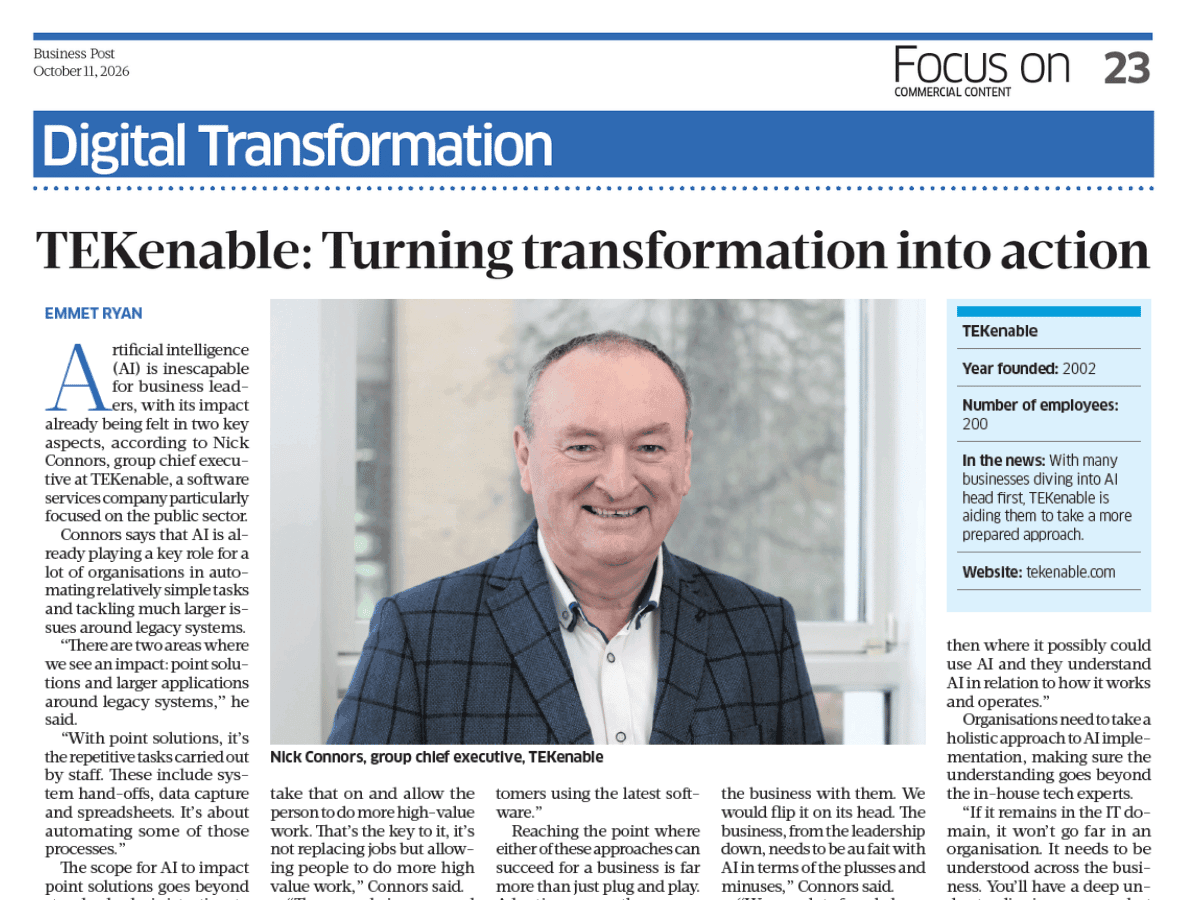
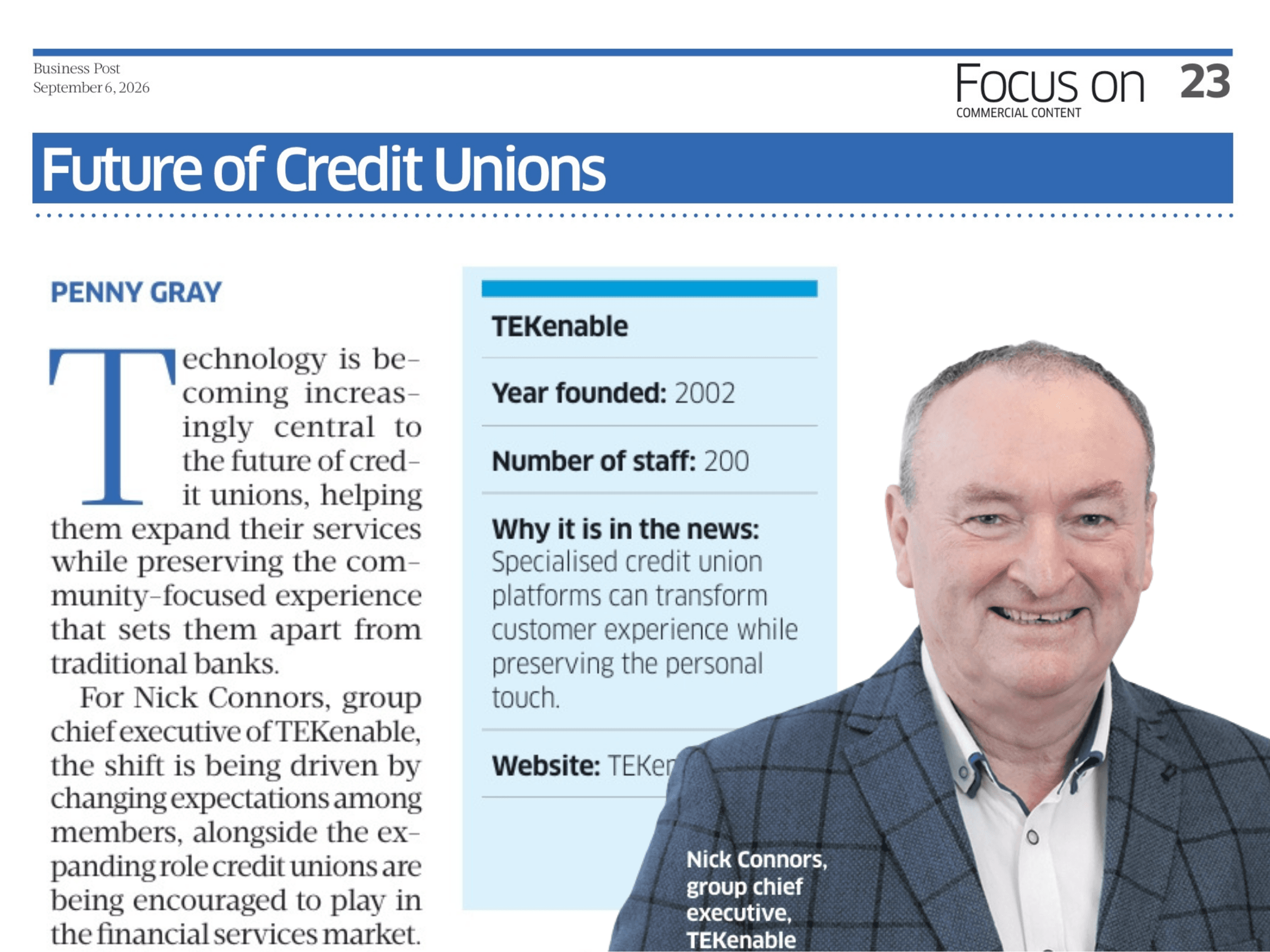
“I certainly think we’re well up there. Are we leaders, no, but we are in the top five in terms of our investment and our rollout of digitisation within the government,” said Nick Connors, group chief executive of the Dublin-based software developer and AI and data specialists TEKenable.
This will only increase, Connors said, as the government has already announced its plan for further transformation of service delivery.
“The critical one, and it’s a really big one, is the Digital Public Service Plan 2030. That’s very ambitious, it says that 100 per cent of public services will be available online, and 90 per cent will be accessed online by users,” Connors said.
The Digital Public Service Plan 2030 specifically aims to simplify the user experience of accessing government services. This, Connors said, is a cultural transformation as much as it is a digital one.
“There is a lot of work that has already been done, but the shift is in what the government wants to do. The fundamental change is that this national plan is very much citizen-centric. What I mean by that is, since the foundation of the state, everything has been department-led, but they are now shifting to looking at key life events, from starting education to starting a family, retiring. Historically you have to go to each department [for each stage], whereas now they are looking beyond that to the citizen [as a whole]. The departments will sit behind that, providing the service, but it will be easier for the citizen.”
“Simple access to services can have a lot of complexity behind the scenes”
MyGovID is one example of where things will likely go: users log in and have access to a huge amount of services.
This, naturally, raises the question of security – after all, citizen information is among the most sensitive data any of us possess. This is fair, Connors said, but it should not be allowed to act as a barrier to delivering for service users.
“Security will always matter but it shouldn’t stop progress. You can always make an excuse, ‘let’s keep the paper’, and that kills efficiency and capability. Security is so advanced that it can be catered for. You do have bad actors out there, but if you don’t do it, you won’t progress,” he said.
The answer, he said, is to bake security into the process, from budgeting through to operations, rather than bolting it on at a later stage.
“It’s about investment. In the past people believed you put the tech up there and that was that, but certainly all of the government departments have a big focus on security now, and it comes hand-in-glove with the investment itself.”
This is analogous with the wider simplification of service delivery, he said: it should be easy for the end user, in this case the citizen, but that does not mean services are built on unsophisticated technologies.
“Simple access to services can have a lot of complexity behind the scenes. In fact we’re already heading there with the electronic health record,” said Connors.
Today, any discussion of transformation, or indeed change of any kind, tends to raise debates about jobs, particularly in relation to artificial intelligence (AI). But cutting staff is not the goal, Connors said.
“The reality is that government departments are being asked to do more with the same budgets, and this is where both AI and digital transformation can facilitate that capability. AI will remove day-to-day processes and allow staff to deal with more complex issues. A great example is an AI programme we have delivered into the Director of Public Prosecution’s office, where the case workload for staff is significantly reduced by the implementation of AI. AI does not, and will not replace staff, but it does allow staff to be far more productive with the same headcount and budget,” he said.
TEKenable also works with Sustainable Energy Authority of Ireland (SEAI) to provide an uncomplicated digital experience to the public for complex services.
“SEAI really is an example to the more traditional departments within government, showing the type of digital services that can be delivered to our citizens,” Connors said.