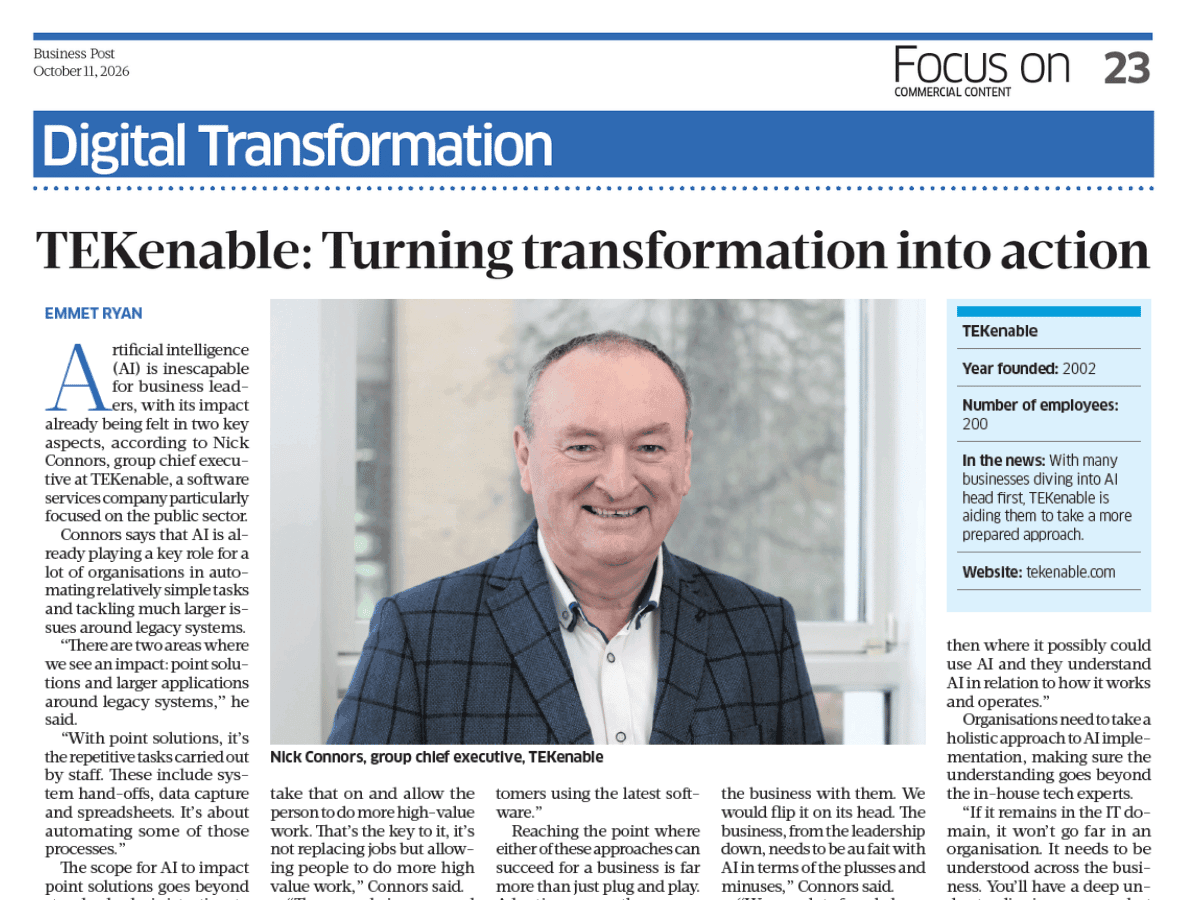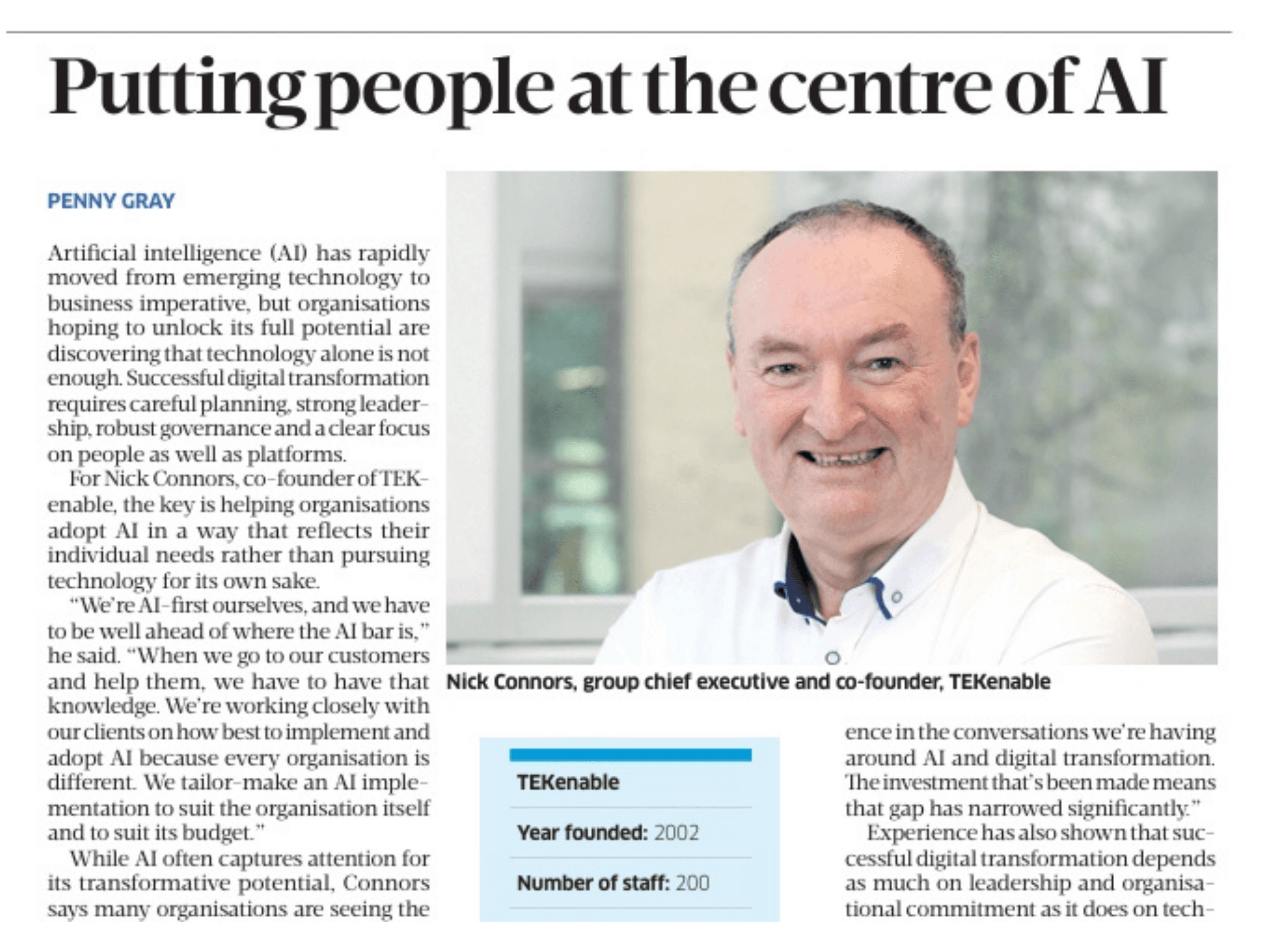
Artificial intelligence has rapidly moved from emerging technology to business imperative, but organisations hoping to unlock its full potential are discovering that technology alone is not enough. Successful digital transformation requires careful planning, strong leadership, robust governance and a clear focus on people as well as platforms.
For Nick Connors, co-founder of TEKenable, the key is helping organisations adopt AI in a way that reflects their individual needs rather than pursuing technology for its own sake.
“We’re AI first ourselves, and we have to be well ahead of where the AI bar is,” he said. “When we go to our customers and help them, we have to have that knowledge. We’re working closely with our clients on how best to implement and adopt AI because every organisation is different. We tailor-make an AI implementation to suit the organisation itself and to suit their budget.”
While AI often captures attention for its transformative potential, Connors says many organisations are seeing the greatest benefits in improving everyday efficiency. Rather than replacing employees, AI is enabling them to focus on work that delivers greater value.
“The biggest value is through becoming more efficient at the operational layer,” he explained. “You’re removing a lot of mundane activities and allowing employees to do higher-level work. Initially, a lot of people were worried they were going to lose their jobs. We’re not finding that at all. What we’re finding is that people are able to do an awful lot more, making organisations far more efficient.”
However, implementing AI successfully depends on strong foundations. Data quality and governance remain critical, particularly as AI systems can access far more than traditional business data.
“Data quality and governance are always front and centre,” Connors said. “AI now opens up a much broader view of your organisation. It accesses not only your data, but your documentation, your emails, your voice, your images and your assets across the organisation. Governance has to wrap around all of that.”
Cybersecurity and compliance must also be embedded into transformation programmes from the outset, rather than being addressed after implementation.
“Security and compliance are always there with digital transformation, and you have to encapsulate them in the same conversation,” Connors explained. “The cloud has made that much easier because your security is within the cloud, your compliance is within the cloud, so when you’re embarking on any digital strategy or AI strategy, those conversations happen immediately.”
TEKenable works across both the public and private sectors and, according to Connors, the gap between the two has narrowed considerably in recent years.
“We work in both the private and public sector, and what’s really pleasing is that there’s now very little difference in the conversations we’re having around AI and digital transformation. The investment that’s been made means that gap has narrowed significantly.”
Experience has also shown that successful digital transformation depends as much on leadership and organisational commitment as it does on technology.
“The first is planning. You can never plan enough. We always say, ‘measure twice and cut once’ before you ever go near the technology,” Connors said.
“The second is executive sponsorship, and it has to be hands-on because that’s key to driving any digital implementation.”
“The third is having a dedicated team within the organisation. They don’t have to be full-time, but they must include both IT and businesspeople dedicated to the programme. If any of those three are missing, organisations will struggle to deliver.”
Connors believes businesses will increasingly evolve into what are being described as “frontier firms” – organisations that combine human expertise with AI capabilities.
“That doesn’t happen overnight,” he said. “You have to plan it, map it out and work with organisations through the journey. It’s not just about technology; it’s about people change and adoption as well.”
For organisations embarking on digital transformation, that combination of strategy, governance and people-focused change will be just as important as the technology itself.