Artificial intelligence is rapidly moving from pilot projects to production lines across manufacturing. For an industry defined by tight margins and relentless global competition, even small efficiency gains can have an outsized impact.
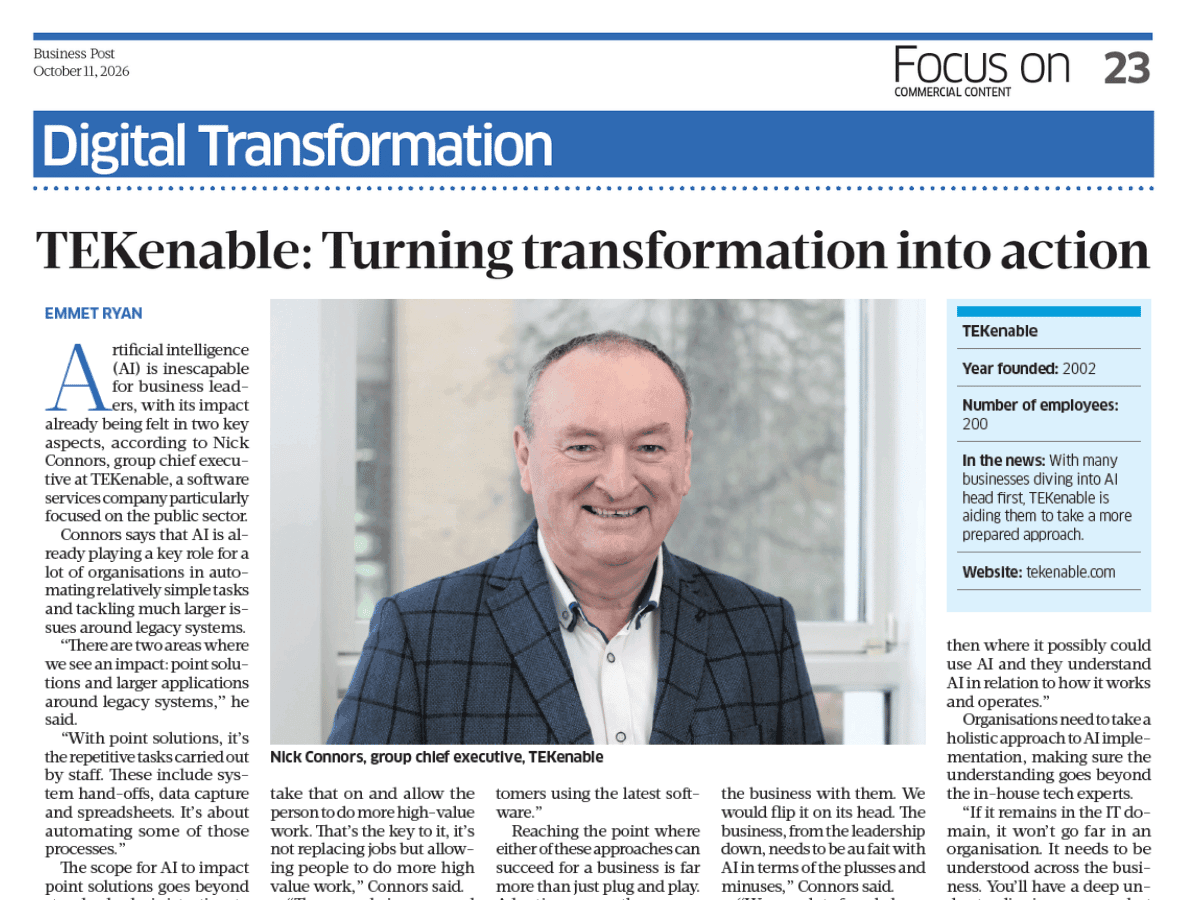
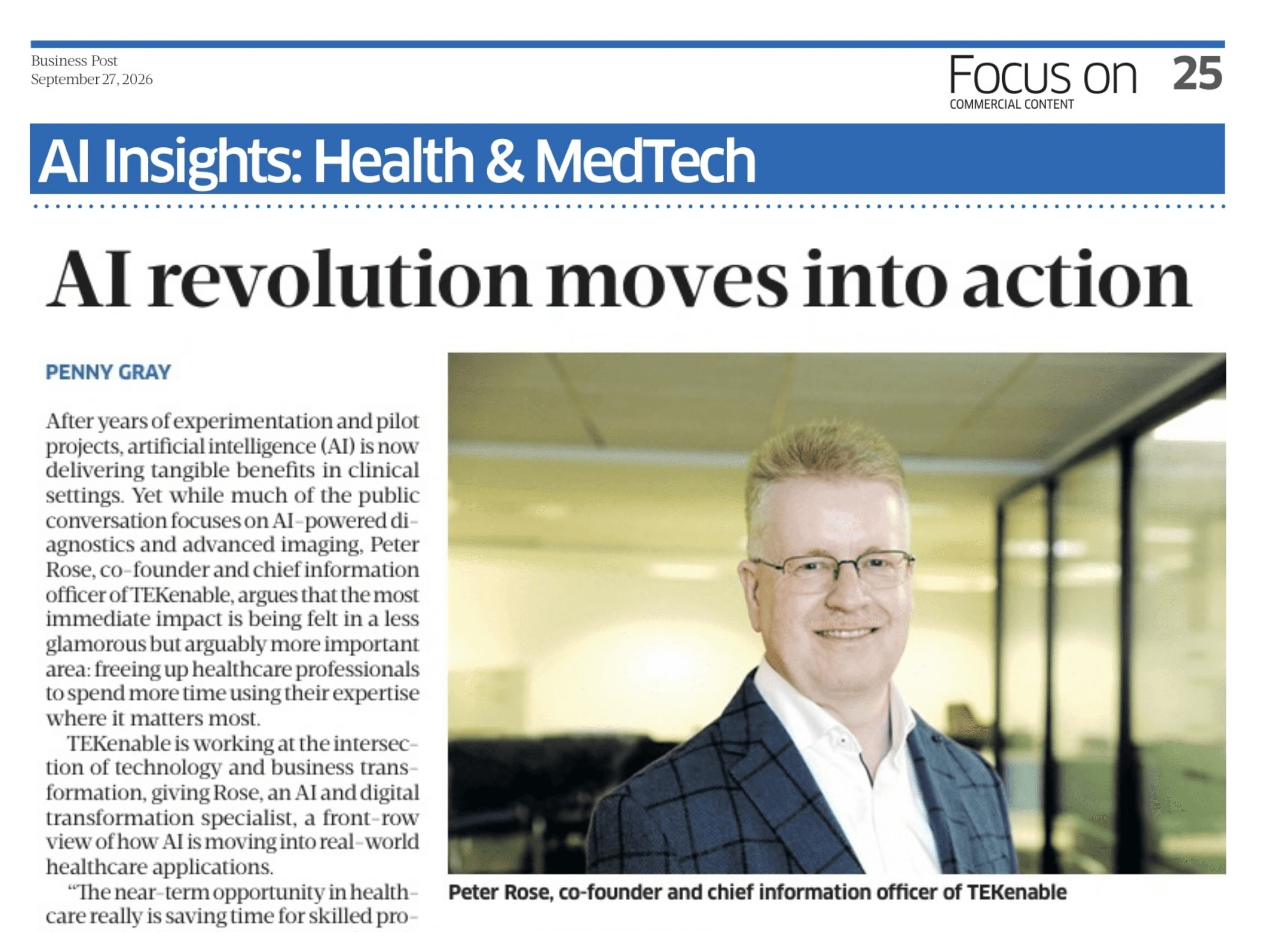
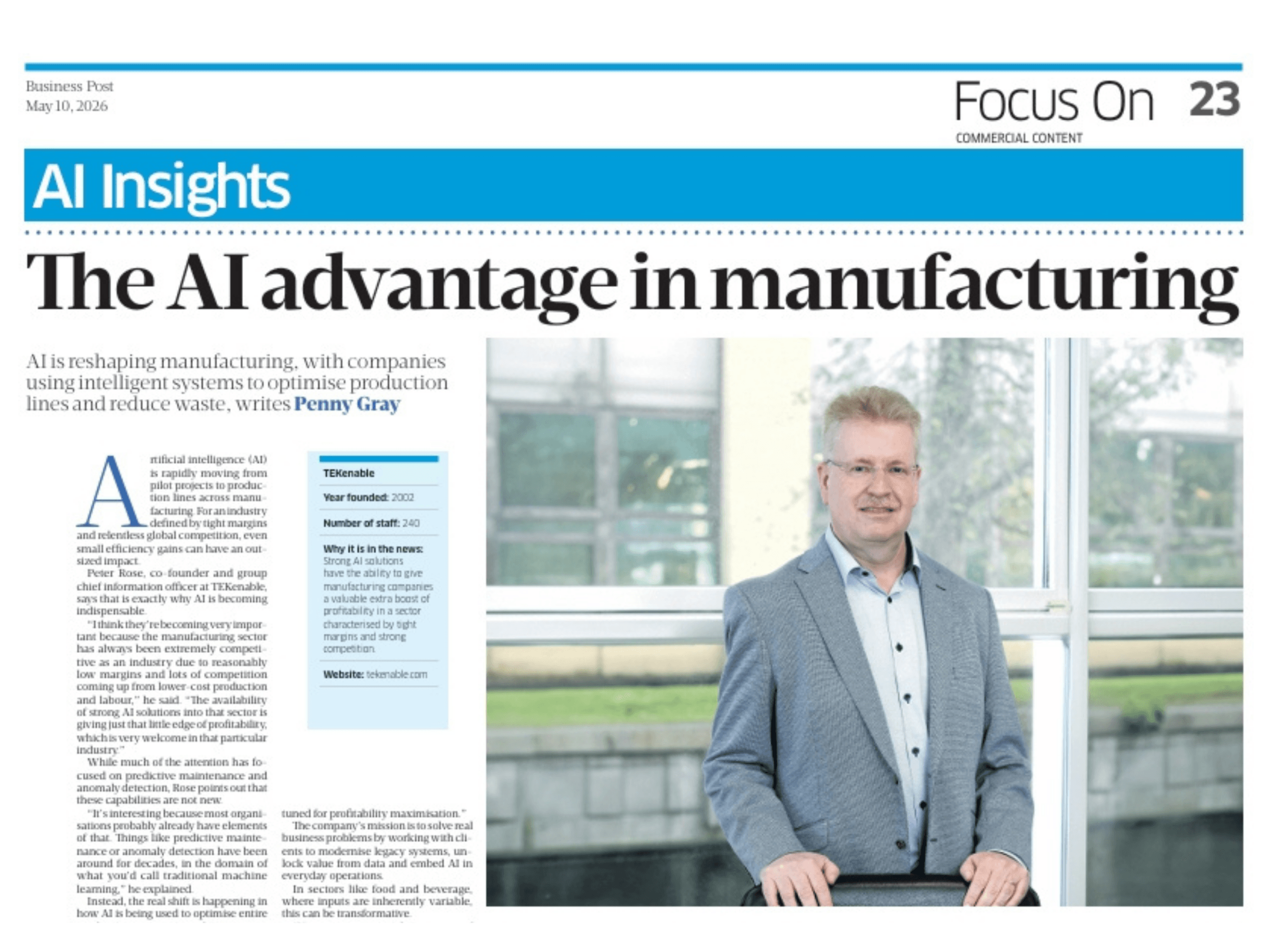
Peter Rose, co-founder and group CIO at TEKenable, says that is exactly why AI is becoming indispensable.
“I think they’re becoming very important because the manufacturing sector has always been extremely competitive as an industry due to reasonably low margins and lots of competition coming up from lower-cost production and labour,” he said. “The availability of strong AI solutions into that sector is giving just that little edge of profitability, which is very welcome in that particular industry.”
Company Details
- TEKenable
- Year founded: 2002
- Number of staff: 240
- Why it is in the news: Strong AI solutions have the ability to give manufacturing companies a valuable extra boost of profitability in a sector characterised by tight margins and strong competition.
While much of the attention has focused on predictive maintenance and anomaly detection, Rose points out that these capabilities are not new.
“It’s interesting because most organisations probably already have elements of that. Things like predictive maintenance or anomaly detection have been around for decades, in the domain of what you’d call traditional machine learning,” he explained.
Instead, the real shift is happening in how AI is being used to optimise entire production systems in real time.
“What we’re actually seeing ourselves – and we’re doing projects in this space – is optimisation of the production line,” he said. “So optimisation of machine utilisation through better production planning, tuned for profitability maximisation.”
The company’s mission is to solve real business problems by working with clients to modernise legacy systems, unlock value from data and embed AI in everyday operations.
In sectors like food and beverage, where inputs are inherently variable, this can be transformative.
“You get raw materials in… some of those are coming straight from the farm and they vary in moisture content and various other parameters,” Rose said. “What we’re doing is using AI to vary the machine parameters according to what it’s actually going to get – the actual properties of that – to optimise the output.”
Beyond adjusting machinery, AI can also continuously reconfigure production schedules to minimise downtime across interconnected systems.
“We’re also sequencing batches as they come through,” he explained. “If it’s going to take longer to process batch A because of the inputs and their characteristics, maybe we should process batch B first, because that enables another machine to continue working and have no downtime.”
In complex manufacturing environments, this kind of optimisation quickly moves beyond human capability.
“Looking at all the constraints and interrelationships and optimising that is a Herculean effort for a human being to do,” he said. “But it’s fairly straightforward for AI.”
Interestingly, Rose challenges the assumption that only large manufacturers are in a position to benefit.
“There’s a presumption that smaller companies maybe aren’t introducing AI,” he said. “But actually, smaller companies, in my experience, find it easier to introduce AI.
“They tend to have more flexibility in what they do, a flatter managerial structure, which makes it easier to effect change. They also have less equipment, so it’s quicker and less costly to apply this sort of thing.”
By contrast, large-scale industrial operations face significant barriers to implementation.
“If you have a plant that is miles across and employs 10,000 people, it’s extremely hard to put something like that in there, comparatively speaking, because of the scale of change that’s needed,” he said.
For TEKenable, supporting manufacturers through that complexity is a core part of its offering. The company is a Microsoft Advanced Specialist in AI, a certification that is independently audited to ensure best practice and real-world delivery capability.
“The independent accreditation is important as it proves that you’re creating AI solutions in alignment with best practice and that you are actually delivering value to customers,” Rose says. “So we’re independently certified as good at what we do.”
The firm is already applying that expertise in live manufacturing environments.
“We’re currently integrating into SCADA and IoT for monitoring and then eventually direct control of the machinery and the production lines,” he says.
TEKenable’s cross-sector experience, which spans healthcare, financial services and beyond, allows it to bring transferable insights into manufacturing.
“You’d actually be surprised how much of a commonality there is across industries in terms of what you can do and how you can do it,” Rose adds.
While client details remain confidential, the scale of current projects is significant, including high-volume beverage production and complex food manufacturing operations.
For Rose, AI is no longer optional in manufacturing environment. In a sector where efficiency is everything, those who can adapt fastest will be best positioned to compete, and increasingly, that adaptability will be driven by intelligent systems rather than manual processes.
As he concluded: “We’re here and we can help.”