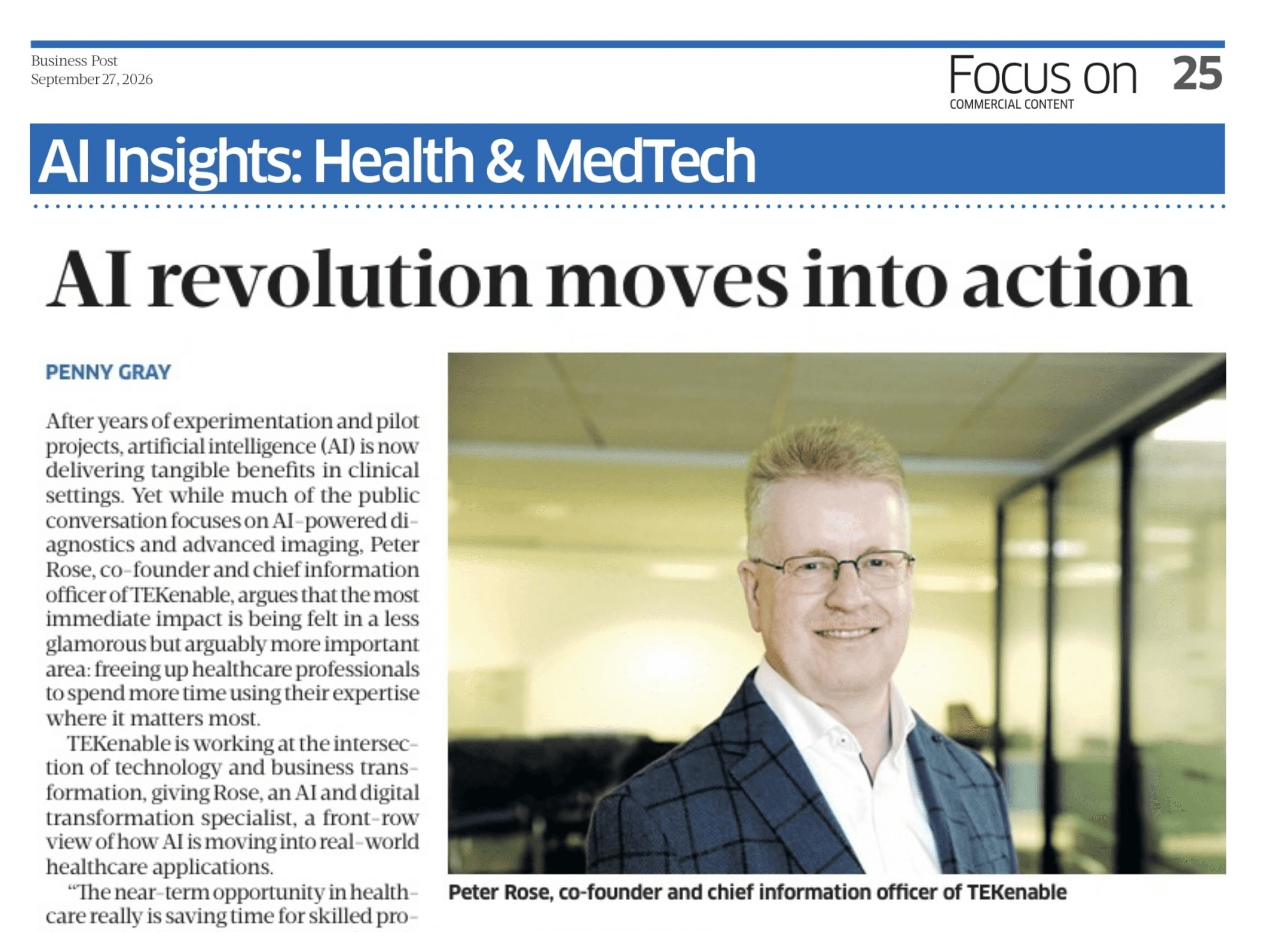
“Whilst AI may not lead decision-making, it is highly effective at supporting it.”
Peter Rose, Group Chief Technical Director, TEKenable
Many organisations are drowning in customer feedback: from queries and complaint e-mails and social media posts to Tripadvisor reviews, local forum discussions, and solicited post-purchase responses, organisations receive an enormous quantity of valuable information that is locked up in unstructured comments that don’t fit neatly into traditional databases.
However, artificial intelligence (AI) is transforming how organisations analyse this previously opaque data, turning customer sentiment into concrete business intelligence, said Peter Rose, group technical director of TEKenable.
The challenge, he said, has long frustrated business leaders.
Unlike structured data from surveys or forms, unstructured feedback from complaint lines, social media platforms, review sites – including Google and Tripadvisor – and local interest groups has remained difficult to analyse effectively.
“Historically, this type of analysis was limited to structured data,” Rose said.
Rose has observed a growing trend across industries as organisations leverage AI’s research capabilities to identify diverse feedback sources, then use additional AI tools—such as AI Recruiting Software—to discern what customers genuinely like and dislike.
Following this analysis, companies can ask targeted questions, such as: is this feedback concentrated in specific geographic regions or, does it pertain to certain customer cohorts?
The breakthrough has come through AI copilot platforms, which make sophisticated analysis accessible to non-technical users.
“We can input the data and instruct the AI: ‘Here are the things we want to know. Tell me the most positive comments, the least positive, and if there are any apologies’,” Rose said. “You can ask specific questions like that to truly dive into the feedback.”
The practical impact can be immediate and compelling. During a recent workshop with a large multinational company, Rose analysed its online reviews in preparation.
“I discovered a consistent issue, which led the head of sales to exclaim, ‘I told you there was an issue’,” he said. “The key difference was that this was no longer just a feeling; it was a concrete, verifiable point.”
Crucially, the technology doesn’t require massive datasets to deliver value.
“Sometimes, you don’t need a massive amount of data. You can process it once and ask the AI a series of categorisation questions. We’ve reached a point where we can take previously opaque, unstructured text, interrogate it, and make sense of it.”
The technology offers businesses a competitive advantage by enabling them to address emerging issues and identify unmet customer needs more quickly than traditional methods allow. This can shift organisations from reactive problem-solving towards more strategic, data-driven decision-making, which is very helpful also for teams with virtual assistants.
However, the technology’s role remains supportive rather than directive.
“Whilst AI may not lead decision-making, it is highly effective at supporting it,” Rose said. This supporting function can reveal significant blind spots, such as for retailers who can remain unaware of products customers want but cannot find.
However, Rose cautions against relying on basic sentiment analysis, which can produce misleading results.
“Traditional sentiment analysis might rate a sarcastic phrase like, ‘I will, yeah’ as highly positive, failing to handle sarcasm, humour, and other nuances effectively. You cannot realistically use it at the comment level for accurate insights,” he said.
The solution lies in aggregation. “You can roll up sentiment analysis to a macro level. For call centres, for example, it’s perfectly feasible and can provide valuable aggregated insights.”
The transformation represents a fundamental shift in how businesses understand their customers. As Rose observed: “You can also teach the AI to recognise specific patterns or sentiments.”
The above text was reproduced from the interview published in BusinessPost on June 09th, 2025.