Enterprise resource planning (ERP) implementations have always sought to be the single source of truth, but technological changes are driving ERP deeper into business infrastructure. Advising organisations on future-proofing their ERP investments is not a one-size-fits-all process
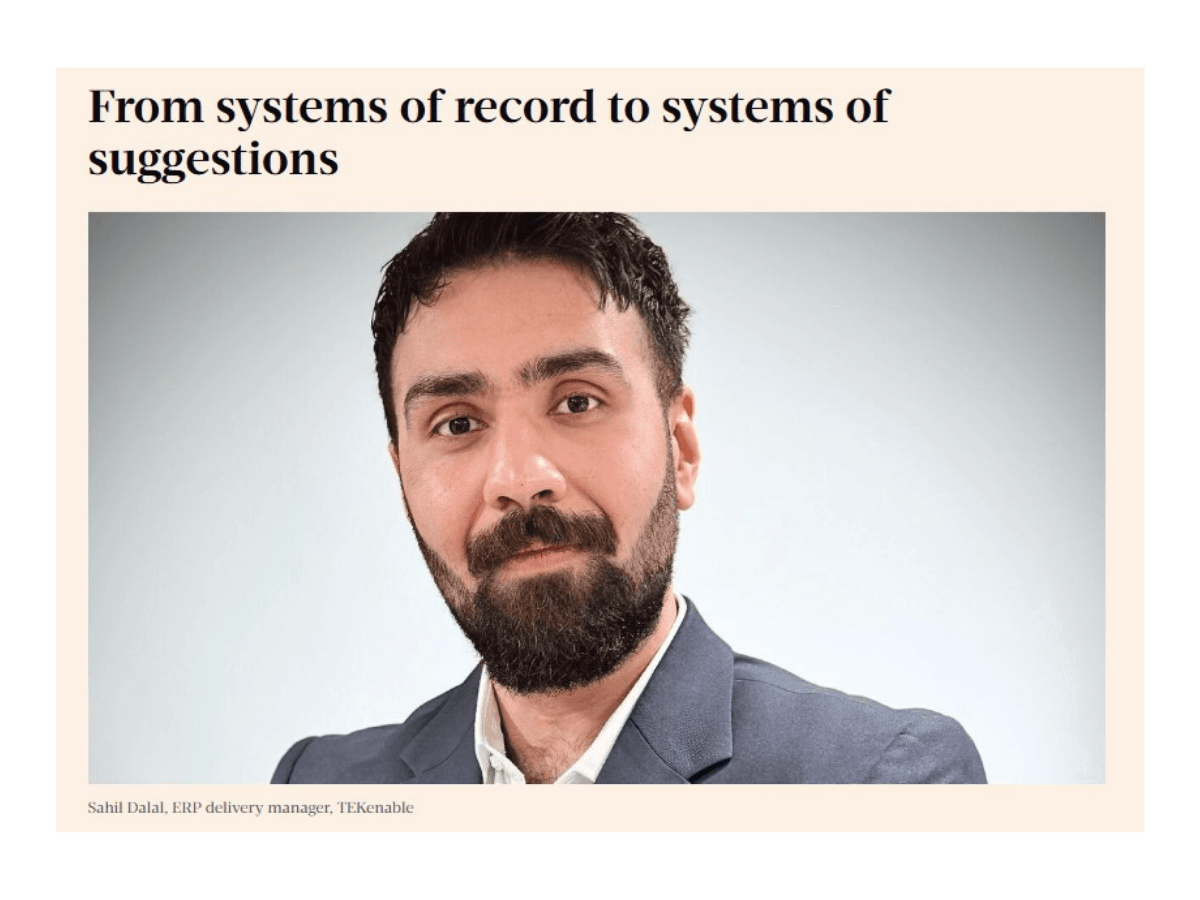
Sahil Dalal, ERP delivery manager at TEKenable said that the key is to focus on the business.
“The way I look at it, the decision today is less about servers and infrastructure and more about the infrastructure. We all know cloud offers scalability, adaptability and continuous improvement,” he said.
In practical terms, this means there is an ongoing general shift to cloud-based systems such as Microsoft Dynamics 365.
On-premise installations can still make sense for some industries, Dalal said, particularly where there are strict sovereignty issues, for example in government and defence. On the whole, however, the cloud makes sense – and not simply for technological reasons.
“Some countries have unstable internet, too, and then there are some [businesses] that are just complex in terms of integration. However, on-premise comes with higher overhead and slows your innovation. Cloud ERP has moved from being an ‘IT choice’ to a business decision; it’s business-led.”
Thinking about thinking
Today, integration of artificial intelligence (AI) and machine learning (ML) is changing the ERP landscape. Indeed, in the face of relentless AI hype, ERP is one key business area where the technology’s application is not speculative.
“ERP is moving, in my opinion, from being the system of record to the system of recommendation. When you’re talking about AI [in the context of ERP], the practical upshot is the ability to do things like predictive demand forecasting, cashflow forecasting, and intelligent anomaly and fraud detection.”
In addition, Dalal said, agentic AI has moved the needle because it is now capable of taking action for users.
“Thinking should be for complex things only”
“When I think about how I ended up in this world: at uni, ERP was one lecture, just a couple of slides, really. As a result, to learn the system I had to learn how the business works,” he said.
“With AI, people are spending time with higher value work. The simple way I look at this is, AI is turning ERP into a decision-making partner, to predict demand, spot anomalies and allow people to act more confidently,” Dalal said.
One way of thinking about this is that AI should enable users to lessen the cognitive load created by mundane tasks.
“Thinking should be for complex things only,” he said.
This philosophical shift has practical implications for how TEKenable approaches ERP projects. Rather than starting with technical specifications, the focus begins with understanding business pain points and desired outcomes.
“Companies typically come to the market when the system is starting to block them, so what is happening is they have pain points. We map the business processes to outcomes and it is not unusual to find that they are carrying a lot of technical debt. What we want is to not carry it forward.
“Future-proofing ERP is about layering: you build a strong foundation and then expand it,” he said.
This layered approach to ERP future-proofing has led TEKenable to favour a comprehensive ecosystem that can grow with clients’ needs. “Microsoft has conquered the business world three times, the first time was with Word, Excel and Outlook. The second time was just during the pandemic: people were talking about Zoom calls, but now they talk about Teams – and there is a reason for that the third is ERP,” Dalal said.
“The difference between Microsoft and everyone else is that Microsoft has an ecosystem that does literally everything.”
The above text was reproduced from the interview published in BusinessPost on September 07th, 2025.
ERP Systems in Modern Business FAQs:
What is the difference between traditional ERP and modern ERP systems?
Traditional ERP systems focused on being a system of record storing and organising business data. Modern ERP systems, especially cloud-based ones like Microsoft Dynamics 365, are evolving into systems of recommendation, using AI to support decision-making.
Why are businesses shifting from on-premise ERP to cloud ERP?
Cloud ERP offers scalability, adaptability, and continuous improvement. While on-premise may still be suitable for industries with strict data sovereignty requirements, cloud ERP reduces overhead and accelerates innovation.
How does AI enhance ERP functionality?
AI enables predictive forecasting, anomaly detection, and intelligent recommendations. It transforms ERP into a proactive partner that helps users make confident decisions and focus on high-value tasks.
Is ERP still an IT-led decision?
No, ERP decisions are now business-led. The focus has shifted from technical infrastructure to strategic outcomes, aligning ERP implementation with business goals and pain points.
What is agentic AI and how does it apply to ERP?
Agentic AI refers to systems that can take action on behalf of users. In ERP, this means automating routine decisions and reducing the cognitive load, allowing teams to concentrate on complex problem-solving.
How can businesses future-proof their ERP investments?
By adopting a layered approach starting with a strong foundation and expanding through modular capabilities. TEKenable recommends mapping business processes to outcomes and leveraging Microsoft’s ecosystem for long-term scalability.