Artificial intelligence (AI) may be rapidly becoming part of everyday workplace technology, but organisations are adopting it at very different levels.
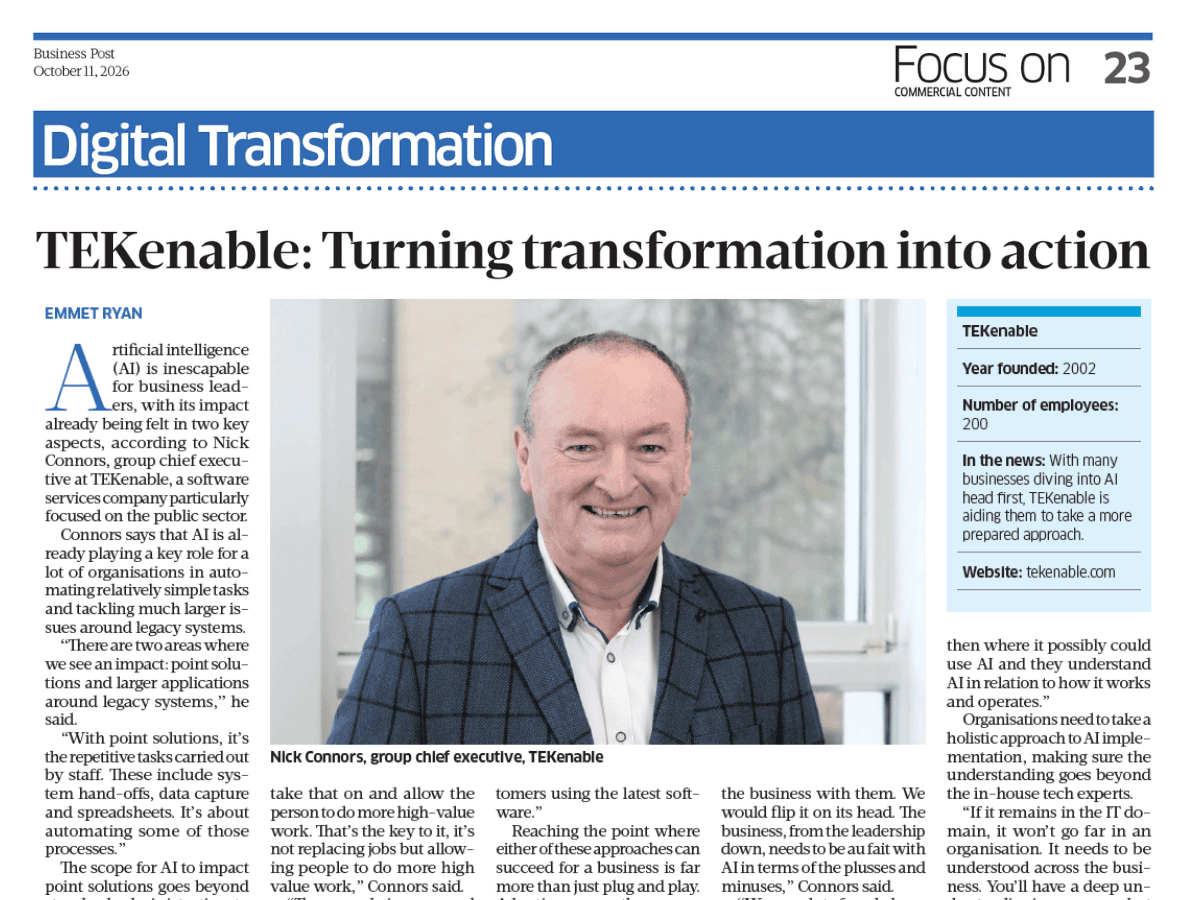
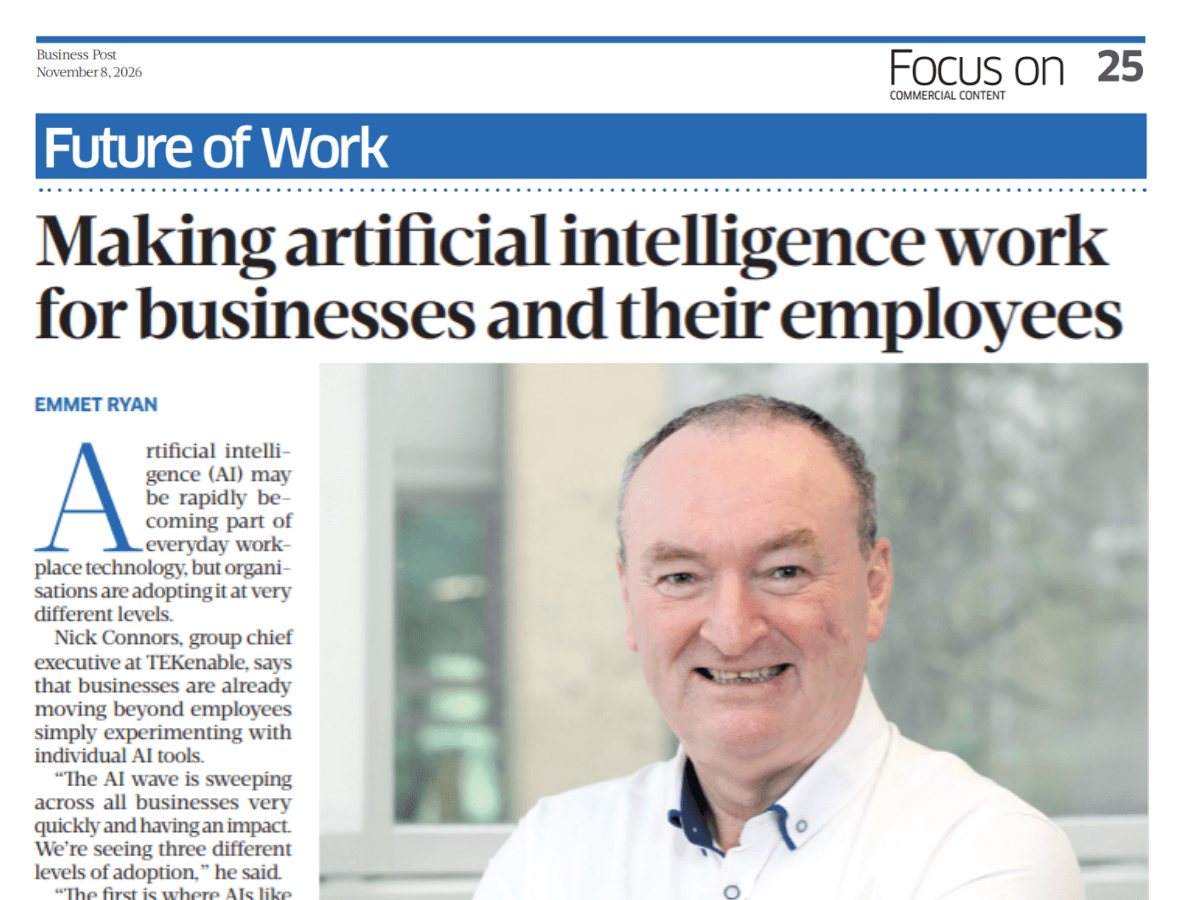
Nick Connors, group chief executive at TEKenable, says that businesses are already moving beyond employees simply experimenting with individual AI tools.
“The AI wave is sweeping across all businesses very quickly and having an impact. We’re seeing three different levels of adoption,” he said.
“The first is where AIs like Copilot and other tools are being used by staff across all departments. The next level is adopting AI agents for organising and identifying processes in their business. The third level is deeper again, where businesses are implementing projects or programmes with AI at the core.”
For organisations combining new technologies with hybrid and flexible working, Connors said that cloud infrastructure has become fundamental to providing both accessibility and security.
“The bottom line here is that you have to move to the cloud. Hybrid and flexible work has to operate in the cloud for security purposes but also for flexibility. Hybrid and flexible working means you’re not just sitting in the office, you’re also on the road or working from home,” Connors said.
“You can only do that if your business applications and data is sitting in the cloud securely. On top of that, that’s where you can really use AI. It’s far easier to implement AI once your applications and data are in the cloud environment.”
While much of the discussion around workplace AI has focused on productivity, there is also an opportunity to use automation to improve the day-to-day experience for employees.
“AI will remove mundane tasks from staff. It will make them more productive. The bottom line is there is nothing worse than doing repetitive daily and weekly tasks that are really thankless. These are more prone to error, so there’s actually a bigger risk to employees,” Connors said.
“Removing that drudge from the day to day will improve the wellbeing of the employees, the workforce. It allows them to do more challenging work, from a worker perspective they feel better in themselves than doing the drudge of reconciling documents.”
That means productivity gains do not necessarily have to come from asking employees to work harder or handle greater volumes. Technology can instead remove work that isn’t valued significantly and leave people with more time for tasks requiring judgement, creativity or specialist knowledge.
The technology itself, however, is only part of the challenge. Connors said organisations can undermine adoption if AI is treated primarily as an IT project rather than a wider change in how the business operates.
“The biggest deficiency is that some businesses treat AI as just a piece of technology that is led by the IT department. That’s a big no-no. AI has to be treated holistically across the organisation with training, upskilling and reskilling across the organisation to allow a significant implementation,” he said.
Giving employees practical experience with the technology can also help businesses manage concerns about how AI may affect their roles.
“An easy introduction to an organisation is to use the likes of Copilot, where staff can safely work with AI in a controlled environment. They then see the benefits of it. They can then implement agents,” Connors said.
“Staff will then understand the direction of travel with AI rather than seeing it as a threat to their own jobs.”
For organisations considering their next steps, the challenge is therefore to combine the right technical foundations with training and a clear understanding of how the technology should improve work.
Connors stressed that this needn’t be a cause for excess concern with businesses making the change as there is ample help at hand.
“If any business has questions about how to start using AI, there are plenty of companies like TEKenable that can help,” he said.
AI adoption may be accelerating, but getting employees comfortable with the change will be central to whether businesses realise the potential productivity and wellbeing benefits.