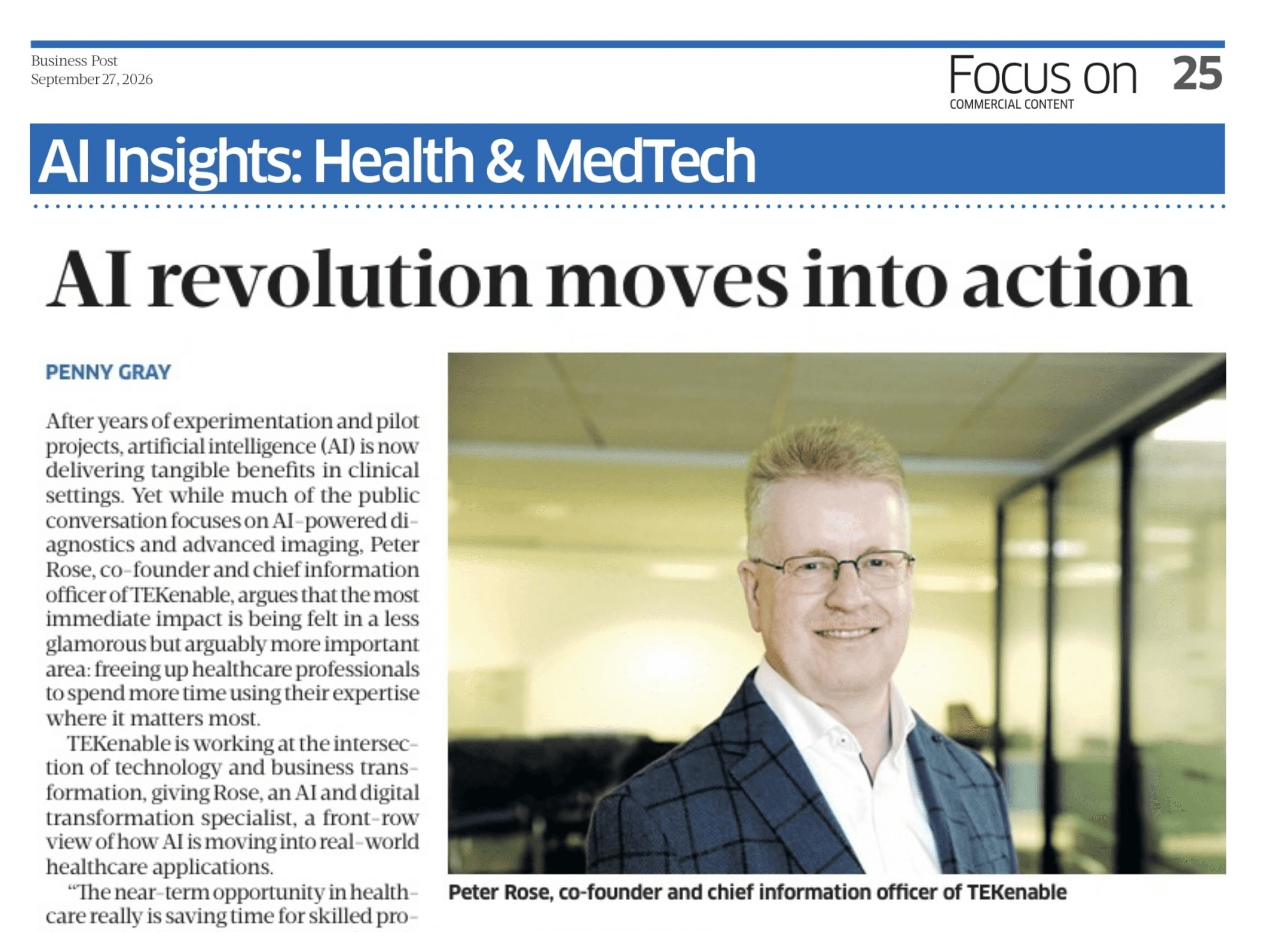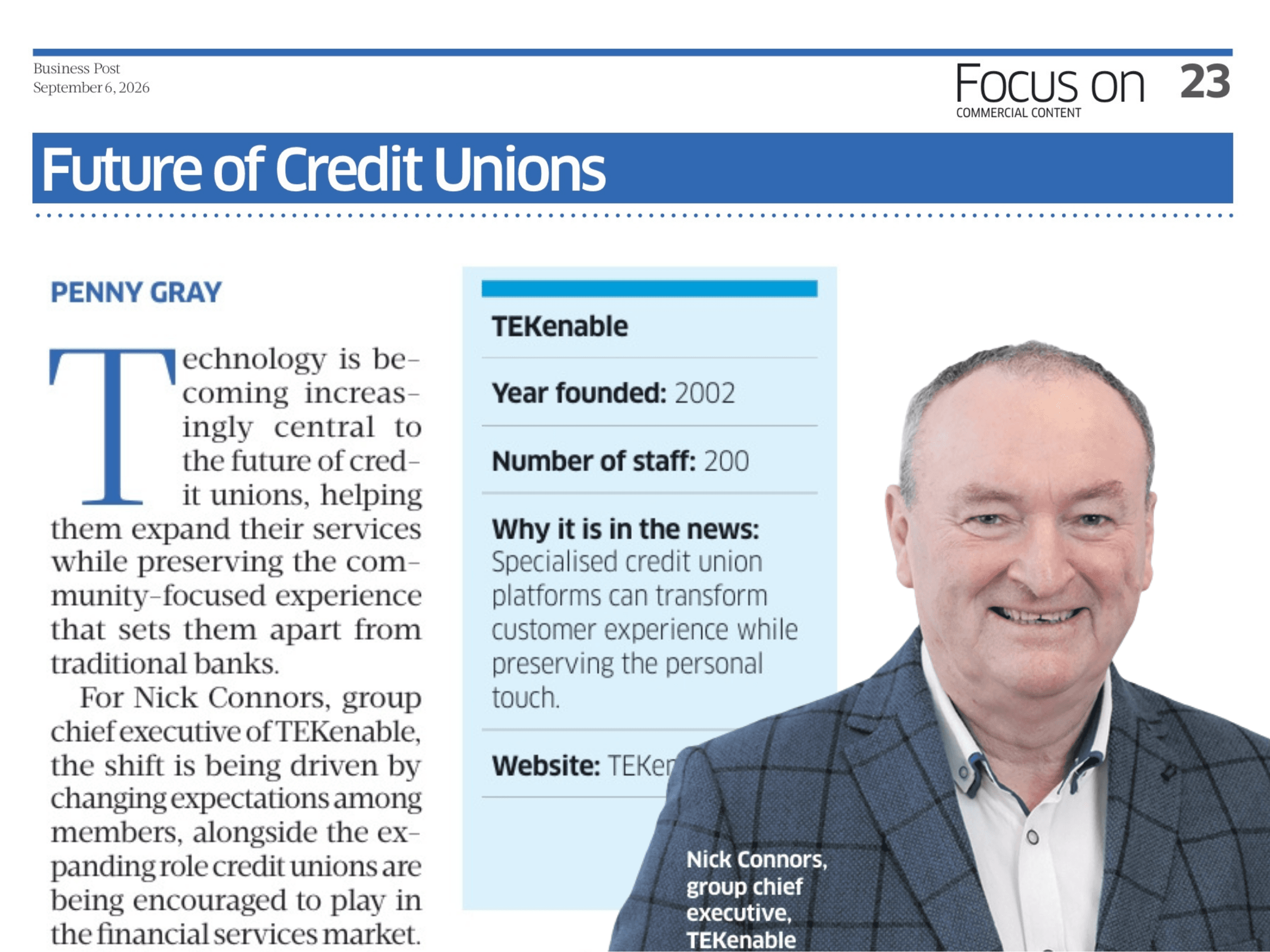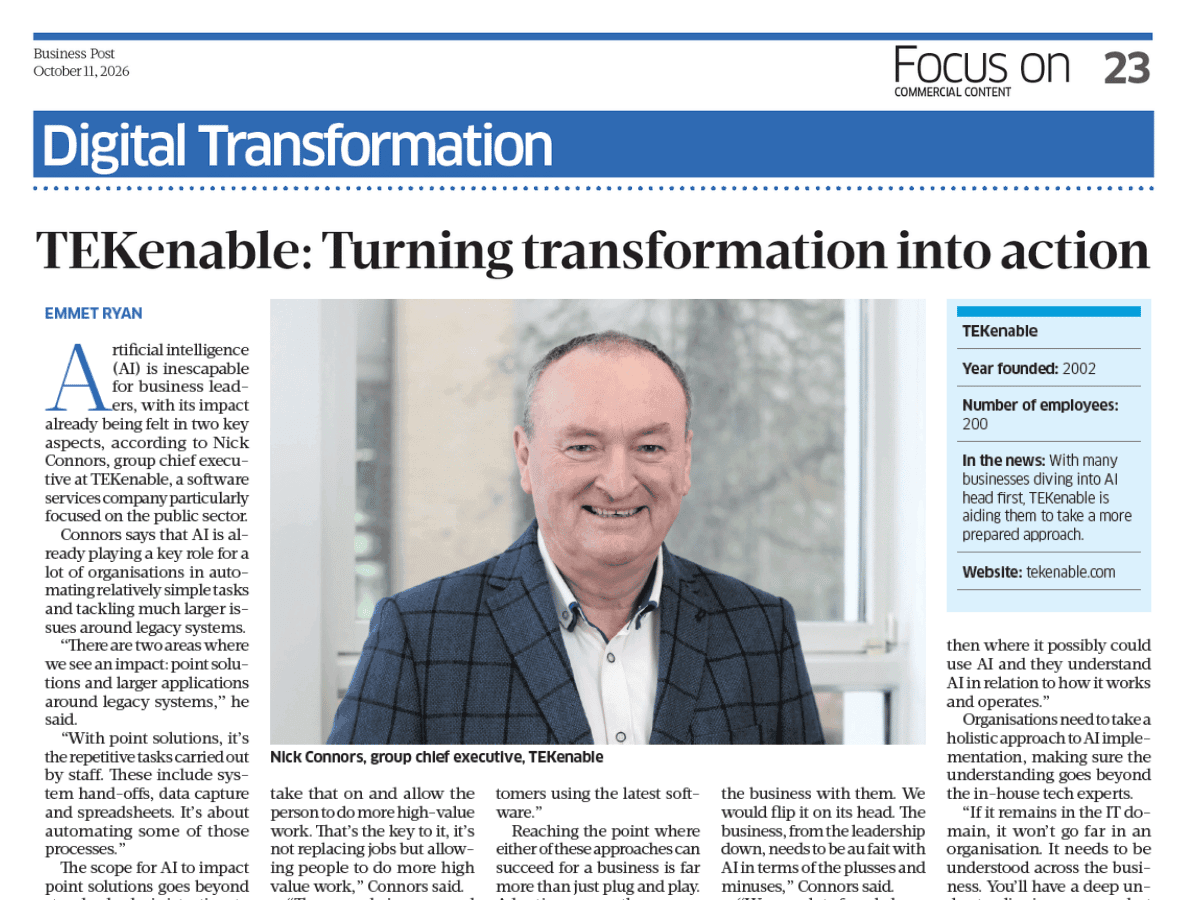
Artificial intelligence (AI) is inescapable for business leaders, with its impact already being felt in two key aspects, according to Nick Connors, group chief executive at TEKenable, a software services company particularly focused on the public sector.
Connors says that AI is already playing a key role for a lot of organisations in automating relatively simple tasks and tackling much larger issues around legacy systems.
“There are two areas where we see an impact: point solutions and larger applications around legacy systems,” he said.
“With point solutions, it’s the repetitive tasks carried out by staff. These include system hand-offs, data capture and spreadsheets. It’s about automating some of those processes.”
The scope for AI to impact point solutions goes beyond standard administration to covering a broad range of mundane and repetitive tasks.
“With back office automation it’s the same. Anywhere you have someone tied up with mundane roles, AI can take that on and allow the person to do more high-value work. That’s the key to it, it’s not replacing jobs but allowing people to do more high value work,” Connors said.
“The second piece, around larger AI applications and implementation. That’s focused on either replacing older systems or putting a layer across them. This makes for a much better interaction with customers using the latest software.”
Reaching the point where either of these approaches can succeed for a business is far more than just plug and play. Adoption across the organisation should come before implementation.
“It’s critical. In the early days, people just dived in with IT teams putting in solutions. That approach didn’t bring the business with them. We would flip it on its head. The business, from the leadership down, needs to be au fait with AI in terms of the plusses and minuses,” Connors said.
“We run a lot of workshops bringing people up to speed and bringing the business up to speed across the board. Then we allow IT or technology to step in. The business will have identified areas by then where it possibly could use AI and they understand AI in relation to how it works and operates.”
Organisations need to take a holistic approach to AI implementation, making sure the understanding goes beyond the in-house tech experts.
“If it remains in the IT domain, it won’t go far in an organisation. It needs to be understood across the business. You’ll have a deep understanding in some areas but everyone needs to have some sense of the pros and cons as well as the direction of travel,” Connors said.
In order to do that, it’s important to know where an organisation actually stands before investing and implementing.
“We see a lot of people diving into solutions without looking at the problem they have right now and putting some simple KPIs (key performance indicators) on what they have. If you don’t measure where you stand at the minute, it’s hard to say whether or not AI has helped,” Connors said.
“We had an example with a credit union that we’re working with. They had identified eight or nine areas that they believed AI would help them. When we did the analysis, we found there were two or three areas where the cost benefit analysis didn’t justify the investment.”
That example explains quite clearly why AI should only be applied once the business case to use it has been made clear. “You need to look at where the problems are, look at them closely, and ask yourself if AI can really enhance it. Then you make the investment decision,” Connors said.
Even when there is a strong business case, there are other matters to take into consideration. The most obvious of these is the quality of the data being used.
“The second big issue is data readiness. If your data isn’t in a state of readiness, pointing AI at it will make a bigger problem. Thirdly, over-scoping or overpromising is an issue. The impact is incremental, the impact happens over time, not as one big bang.”
AI may be inescapable but it’s not a catch-all solution. For businesses to use it well, they must treat it like any other tool and find its best use. Otherwise they might end up taking a sledgehammer to a walnut